Posts Categorized: Posts

Mysteries of “Mysteries of Lisbon”

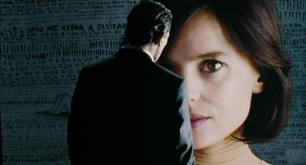
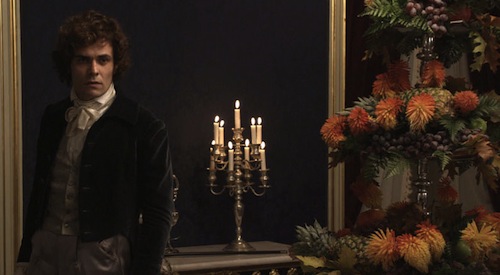
“Mysteries of Lisbon” is a 2010 film of epic proportions, a 4 1/2 hour Portuguese-French period drama that was included on several Best Of lists last year. It’s a visual stunner — every shot looks like a 19th century oil painting, not to mention the fascinating camera work, long takes, and bold editing. But for me the big mystery watching this film was “what is this music??” Two names are listed under the music credit on the movie’s web site: Jorge Arriagada and Luís de Freitas Branco.

Sr. Arriagada is a Chilean countryman of the film’s director, Raúl Ruiz, and has been one of his most frequent collaborators. His name is listed as the sole musical credit (“Original Music by”) on MoL‘s imdb page and in the film’s credit reel, which would make you think, OK, this guy must have written the music for the film… so who’s the other name?
Well, it turns out that this is the real mystery of Mysteries of Lisbon. Here’s some copy from the film’s web site:

To allow the Lisbon of the 19th century to ring true, Ruiz turned to the music of the great Portuguese composer Luí­s de Freitas Branco, a name that is synonymous with the Portuguese culture of the 20th century. His work continues to be a reference, with special mention for Paraísos Artificiais and Vathek, considered the jewels of modernism he himself created. He composed four symphonies of a classic quality that truly denote his appreciation for the polyphonic past of Portugal.

He died in 1955.

I found this text rather intriguing. (Let’s ignore for a second the fact that this was obviously and poorly translated from god-knows-what Romance language and that the phrase “polyphonic past of Portugal” is probably the title of some lame musicologist’s blog.) I may know nothing of the Portuguese culture of the 20th century, but I do know a few things about modern music, and I had never come across the name Freitas Branco, much less the music he wrote.

So began the investigating. It turns out that Sr. Freitas Branco’s entire orchestral output has been released on Naxos (who else?) as recorded by Alvaro Cassuto and the Ireland RTE National Symphony Orchestra. And what an output it is.

Having now listened through Freitas Branco’s four symphonies, two orchestral suites, and several tone poems, I can say this: almost all of the music (and all of the distinguished music) used in Mysteries of Lisbon is his. I can also say that Sr. Freitas Branco’s music has nothing to do with the Lisbon – or anywhere else for that matter – of the 19th century, but it has a surprising amount to do with film music of the 20th and 21st centuries.

This composer has flabbergasted me. Some of his music is very derivative indeed; his youthful “Suite alentajana” sounds like a pastiche reenactment of Rimsky-Korsakov’s greatest hits. There’s hints of Chausson and Vaughan Williams and even Bruckner. But this composer also created strikingly original music, most of it very dark in mood, with strident harmonies and brooding orchestration.

Have I piqued your interest yet? Here are some of the themes that feature prominently in Mysteries of Lisbon:

Symphony No. 1 (1924), mvmt. 1:

Symphony No. 1, mvmt 2:

Where did this stuff come from?? It’s so moody and enigmatic, weirdly proto-Herrmann, and — what? — post-Rachmaninoff? It seems custom engineered for film:

Symphony No. 2 (1926-27), mvmt. 2:

This next piece sounds like Stephen Sondheim and Philip Glass teamed up to write a Bruckner symphony:

Symphony No. 3 (1930 – 44), mvmt. 1

But here’s the real kicker, a section from a symphonic poem titled Vathek.  This canon for 59 voices was written in 1913, but it sounds much closer to Ligeti or Schnittke than it does to Stravinsky’s boldest pages (it pre-Bartóks Bartók, while we’re at it):

This stuff is amazing, right? And totally neglected and unknown and we should be playing it at least SOME of the time, right?? I’m so glad it made its way into the soundtrack of Mysteries of Lisbon, and I have to give mad props to Raúl Ruiz, because he used it just right. But, continuing the mini-theme from my last post, it’s at least mildly deceptive that Jorge Arriagada’s name is the default credit for the music in this film. I’m sure Sr. Arriagada made a valuable contribution to the project, and I haven’t gone back and tallied up the music minute by minute, but I’d have to guess that at least 75% of the music in this very long film belongs to Sr. Freitas Branco.

Why not help even out the disparity: buy the Freitas Branco oeuvre here. Not that he’ll really care. But I will! And you’ll enjoy it! And we’ll all be happy! And moody. Oh, and you should watch Mysteries of Lisbon too — it’s really great!

Is Osvaldo Golijov a musical thief?

A potential scandal in the world of contemporary classical music comes to us today from Eugene, OR of all places, via the Eugene Register-Guard.  Bob Keefer writes about the reaction of two audience members at the recent Eugene Symphony performance of Osvaldo Golijov‘s Siderius:

But when the concert opened with Golijov’s “Sidereus,” a 9-minute composition that premiered in 2010 in Memphis, Tenn., the two men looked at each other in shock.

That’s because, both said on Friday, they recognized large parts of Golijov’s composition from a different composer’s piece, one they both had been working with recently: accordionist Michael Ward-Bergeman’s 2009 work, “Barbeich.”

The two gentlemen in the audience that night were Brian McWhorter, a trumpet professor at the University of Oregon, and Tom Manoff, an NPR classical music critic and writer.  Mr. Manoff being the driven journalist that he is, has beaten me to the punch and offered a rather extensive blog post on this developing story in which he analyzes passages of both scores and tells us that they match up in many respects.

Gracious readers, here is a chance to listen and judge for yourselves.

First, a clip from about one minute into Sidereus, ostensibly by Mr. Golijov:

And a parallel fragment from Mr. Ward-Bergeman’s Barbeich for hyper-accordion:

It doesn’t take a musical genius to hear that these clips are two different versions of the same music.  Let’s take a listen to the B section:

Golijov:

Ward-Bergeman:

You get the idea.  Here’s what Mr. Golijov said about the work in an interview with his publisher:

For the “Moon” theme I used a melody with a beautiful, open nature, a magnified scale fragment that my good friend and longtime collaborator, accordionist Michael Ward Bergeman came up with some years ago when we both were trying to come up with ideas for a musical depiction of the sky in Patagonia. I then looked at that theme as if through the telescope and under the microscope, so that the textures, the patterns from which the melody emerges and into which it dissolves, point to a more molecular, atomic reality. Like Galileo with the telescope, or getting close to Van Gogh’s brushstrokes.

While Mr. Golijov may not be able to come up with his own musical ideas, he is certainly a potent generator of BULLSHIT.  What I think he meant to say was that he took Mr. Ward-Bergeman’s theme and created an arrangement.

In his blog post Mr. Manoff writes that he is awaiting responses from both Mr. Golijov and Mr. Ward-Bergeman, and he suspects they must have had a financial or personal agreement.  Certainly they must have.  This “borrowing” is so obvious that Mr. Golijov never could have gotten away with just using it and not saying anything.  But is it plagiarism?

These things are rarely so clear-cut in music.  The various jobs that writers have in the profession – orchestrator, composer, arranger – leave tremendous room for interpretation.  A Composer may be nothing more than a tunesmith or a “whistler”; a professional orchestrator may in fact do the lion’s share of the actual composing.  So who gets the credit?  Look at the case of Robert Russell Bennett, the greatest of the Golden Age Broadway orchestrators: Bennett was a composer in his own right, and his compositions pale in comparison to the great numbers that he orchestrated for the likes of Richard Rodgers.  Rodgers may not have had the time or ability to form his own music into full-fledged musical fabrics, but obviously it was his material that made all the difference.

Then there’s Duke Ellington and Billy Strayhorn.  Who was the composer and who was the arranger?  Were there any such boundaries?  Often one would write the first half of a piece and the other would complete it.  Duke almost always got the credit no matter how much work Strayhorn had done on the music.  But, so the thinking goes, this was to Billy Strayhorn’s benefit: the music sold much better with Duke’s name on it, and Strayhorn reaped significant financial rewards from their arrangement.

At least 9 out of the 11 minutes in Sidereus are based on Mr. Ward-Bergeman’s Barbeich.  Though Golijov adds what I presume to be his own introduction, interlude, and coda, and diverts the melody here and there, I think an honest musician would have to call this piece an arrangement.  Certainly many an arranger has done a lot more work than Golijov did and received less credit for it.  At the very least, I think it’s a little underhanded of Golijov to have fulfilled a commission under his own name with this work if he didn’t clear the concept with his publisher/commissioning agency.

You can listen to the entirety of Sidereus here and the entirety of Barbeich here and make up your own mind: what do you think?

A few additional remarks:

1) Mr. Ward-Bergeman does indeed have a long history of collaboration with Golijov: he is a member of the “Andalucian Dogs” on the Ayre disc, and a musician on the Tetro soundtrack.  Could this piece have been another instance of their musical collaboration?

2) I interviewed the work’s dedicatee, Mr. Henry Fogel, on the occasion of Sidereus‘s Chicago premiere and included a few extra notes about it in a blog post here.

3) “Sidereus” is one of the most awful titles in musical – nay, titular – history.

4) The accordion, and in fact all the members of the squeezebox family, are totally badass.  Witness.

5) This, in case you all didn’t read it already.

The Bilbao Song, pt. II

The Saga Continues…

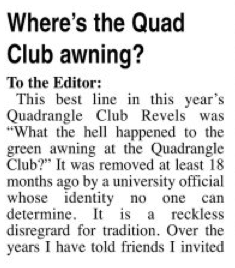
Back in August of 2009, I wrote a hard-hitting exposé about the green awning that once proudly stood in front of the University of Chicago Quadrangle Club at 57th St. and University Ave.  The awning represented something fine and good and upper crust, something with an air of old world exclusivity that is lacking in our modern age.  New management had recently taken over the club, and the awning disappeared without a trace.  My demands for an explanation were met with silence.

After two and a half years, I thought the story was over, and that the awning would never be replaced.  Even worse, I thought that everyone had forgotten about it.  I cancelled my membership at the club.  Between the awning and the new bar stools, it just wasn’t worth it.

Though no longer a member, I continued to write songs for their annual revue, the infamous Quadrangle Club Revels.  The 2012 Revels was a noir styled “thriller”, and in one scene, the ace private eye at the center of the case delivers a line of dialogue about various unsolved Hyde Park mysteries.  I suggested an addition to the script by Andy Austin: how about we include the mystery of the Missing Quad Club Awning?  It took a little convincing, but Andy used the line.

The script was finalized at the beginning of January, and the show went up 4 weeks later.  I couldn’t get to Chicago to see it this year, and frankly, I had forgotten all about that little inclusion (my main concern was the truly filthy song that I wrote for my friend Lauren.)

And then, lo and behold, this letter-to-the-editor appeared in the Hyde Park Herald:

You can imagine the rest.  (I didn’t take a screen shot of the top of the next column.  The Herald makes available only the most recent edition online, in jpg. format.  I know of no better way to sum up Hyde Park.)

The moral of this story is: art matters.  Drama can still be a vehicle for social and architectural change.  This may be only one letter-to-the-editor, but this single voice proves that the cause is not forgotten.  Academic pencil-pushers can’t just go removing awnings at will.  A movement is at hand.

Ruckus

There’s an awful lot of fuss being made today about Alan Gilbert’s confrontation with a NY Phil patron whose cell phone went off during the final measures of Mahler’s 9th Symphony last night.  The errant twitwit aside, internet response seems to be squarely on the maestro’s side, and I concur.  I think he handled splendidly.  I don’t even blame the ushers for not stepping in — they too must have been stunned and reluctant to cause more of a stir by swooping in to discipline a patron seated in the middle of the front row as the last embers of Romanticism died away on stage.

The reports confirm everyone’s suspicions: the offender was an Older Person, so chances are this was an unwitting error on his part.  How many oldsters do you know who regularly hear their cell phone ring in a public (or private) setting?  That’s what I thought.

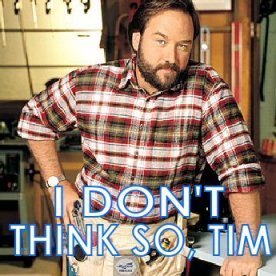
But just last week, I was witness to an audience disruption of a very different sort, one that the press has overlooked entirely.  Picture it: Cincinnati, 2012.  Music Hall.  The Cincinnati Symphony is on stage with Emmanuel Ax playing the Mozart 22nd piano concerto.  The charming first movement cadenza comes to a close and the orchestra re-enters.  It’s a sublime moment, smile-inducing and soul-restoring.  And it’s the very moment when some hooligan in the rafters applauds and barks out a Tim Allenesque bro-call.

Now here’s the thing: I so wish that this idiot had chosen a different concerto/cadenza for his little outburst, because given the right repertoire, I would be totally supportive of this kind of thing.  I’ve been preaching a long time about how we ought to be clapping between movements (since the composers usually WROTE their symphonies with that very reaction in mind) so why not at the end of cadenzas too, alla jazz performance practice?

Sure.  Fine.  Sounds great, but it depends on which concerto and which cadenza.  The Khatchaturian violin concerto?  By all means yes, everyone should be on their feet applauding the end of that cadenza when a violinist really nails it.  That’s what it’s there for.  I mean, that’s basically what the whole concerto is there for – it’s a virtuoso showpiece, and the cadenza takes up like half of the first movement.  Why should we just sit there?  To show reverence for one of the dumbest themes in the repertoire being played in the orchestra?  Ugh.

Dude.  Seriously.  It’s Mozart’s Eb piano concerto.  It’s not showy, it’s not splashy, it’s just gorgeous.  You know you were just trying to get attention and make a “statement” about jazz or classical or something.  Come on.

New year, new piece, raising money, sexy v. non-sexy projects

First off, if anybody would do even an iota of research on this Mayan calendar thing, they would quickly realize that there’s no apocryphal prophecy associated with it.  And where better to go for an iota of research than Wikipedia?  December 21, 2012 is basically just like a new Mayan millennium.  Granted, it would be way more fun if it were an apocalypse, but it’s not, so let’s all just move on, shall we?

Remember a couple months ago when I came begging for money?  Well, I got it!  And then I made a recording of my new piece, which is actually like 10 months old, but so it goes.  Anyway, here it is:

And here’s more about the piece itself, my cantata setting of Psalm 46.

Me in action mode, with xmas wreath.  Photo credit Sam Greene.
The whole Kickstarter thing was a big success, and the Kickstarter site is packed with really helpful info about how to make your project work.  There are also other sites with helpful hints.  But here’s what I would say to composers looking to do a project like mine: classical music isn’t a sexy sell for a project.

(Duh.)

Unlike with other types of projects, random people on the internet are probably not going to contribute to you.  I think I got like three or four, maybe, and I’m still not convinced those weren’t my mother.  Crazy inventions, indie films, and pop records are all much more likely to attract the attention of the people who browse Kickstarter looking to get in on the ground floor of the Next Big Thing.

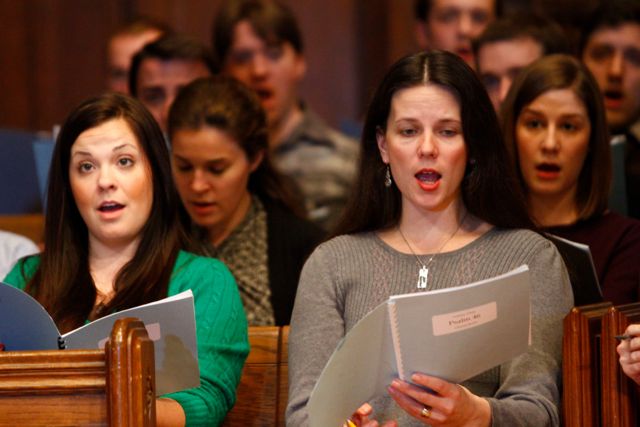
People singing music I wrote because other people donated money online.  Again, photo by Sam Greene.

For example, my friend Will just ran a hugely successful Kickstarter campaign for his movie “Mulligan” — he raised well over $10,000 in less than a week, and a lot of that came from people that he didn’t know.  Ironically, one of the major rewards categories was the score that I wrote for the movie and those randos were eating it up!  This isn’t sour grapes — quite to the contrary, I’m very happy with the money I raised and I’m really glad that his project succeeded too.  The point is that he had lots of people clicking on his link because they’re into indie film, because indie film is like, a thing that people are into.  I’m not sure most people who are into church music actually own mouse-compatible computers.  (I kid!)  [But, you know, kernel of truth.]

So Kickstarter is a tool — a great way to present and communicate your project and a slick interface for processing electronic payments (it’s linked to Amazon).  But you will still have to do the legwork of begging and browbeating your friends, family & colleagues into kicking in.  So good luck!!  Oh and special thanks to all my readers who contributed!!  Glad to have you as my listeners too!

List of Acceptable Christmas Music

I’ll probably submit this to Wikipedia.

1. Sufjan Stevens, Songs for Christmas

I don’t think we give Sufjan nearly enough credit in general, but certainly we should all be bowing down on our knees when December 25 comes around.  Simply put: Sufjan saved Christmas music.  All of it.  All of the familiar carols and songs, the trite lyrics, the pat harmonies.  He redeemed them, re-invented, and glorified them.  And all it took was a banjo and some oboes.

He also wrote some great new classics from scratch:

2. Tomás Luis de Victoria, O Magnum Mysterium

3. Gian Carlo Menotti, Amahl and the Night Visitors

This is likely the best thing Menotti ever wrote.  Pieces like The Medium and The Telephone have so many silly melodramatic moments and text-setting gaffs that they just don’t hold together.  Amahl is simple and tunely, contains a musical setting of the line “This is my box. This is my box. I never travel without my box,” and always makes me cry right here:

4. In Dulci Jubilo

I love the tune, and I love the back and forth between Latin and Olde English.  I love how “show” is spelled “shew”.

5. Alfred Schnittke’s “Stille Nacht

6. John Adams’ El Niño

7. “Glory to God” by Yours Truly

You didn’t seriously think I would leave this out, did you?

8. Benjamin Britten, A Ceremony of Carols

Marginal:

– “Silver and Gold” as sung by Burl Ives on the original Rudolf the Red-Nosed Reindeer soundtrack

– The Vince Guaraldi Christmas Album

– The Little Drummer Boy

– “The Eight Days of Christmas” by Destiny’s Child

Specifically unacceptable:

– Morten Lauridson, O Magnum Mysterium

– This:

– And everything it represents.

– Everything else not specifically on one of the above lists.

Am I missing anything?

Accept No Imposters

I just want to clear up any understandable confusion that may have arisen over the following video:

Though lyrically I may be “untouchable” and “uncrushable”, and though I do fancy myself quite the “dapper chap”, I fear to say that “ho-slapper” is NOT in my job description.  Alas folks, the author of this video is a different William White.  And given my homonym’s guarantee to be here “till the end of the age of Pisces and beyond,” I thought it best to clear up the confusion right now.

Many thanks to AG for bringing this to my attention.

In other news, this list is one of the sillier things I’ve come across, well, ever.

Pedro & Filmic Anesthetia

If you happen to have read this blog in the past few months, you know that I’ve been chomping at the bits finally to see The Skin I Live In (La piel que habito), the newest feature by the great Spanish director Pedro Almodóvar.  So did I see it?  Yes, when it FINALLY opened a few weeks ago in ‘my part of the country’ after its May premiere in Europe.  So why have I remained mute about it?  Well, it’s like this: after I saw it, the only thing I could think was, “I need to see that again.”

La piel had a strange effect on me.  Though it runs for 117 minutes, when the credits rolled, I couldn’t believe that I had just finished watching an entire feature film.  I’m hard pressed to say why.  It’s not like the pace of the narrative was dizzying or frantic.  In fact, when it was over, I had the distinct sense that there were many fewer twists and turns than in a lot of Almodóvar’s plots.

But upon further reflection, I don’t think that’s quite right.  The central plot of the film resolves into one stupendous twist so spectacular that it obfuscates many smaller revelations and surprises along the way.  But that largest of revelations comes about late in the game, and it feels slow to arrive.  Maybe the issue is that the film’s tone is so austere that we aren’t as invested emotionally in the plot’s unraveling.

But this is where it gets really tricky, because I would never say that this movie is “cold”.  It’s not.  It’s got plenty of deep, complex emotions (though no humor to speak of, a major departure for Almodóvar.)  And yet, when the movie was over, I felt numb, like I was coming out of a haze.  There’s something about this film that anesthetizes the viewer to its own content, and I can’t pinpoint what it is.  Nor do I think this is a miscalculation.  Much to the contrary, I think this is exactly what Pedro was after.

And now I’m chomping at the bits to see it again, but it only played for one lousy week in Cincinnati.  Jehovah only knows when it’s coming out on DVD.

Thankfully, the score is out on iTunes, and, as we’ve come to expect from Alberto Iglesias, it’s a humdinger.  Iglesias’ talents are simply amazing.  I don’t know how he manages to match Almodóvar tone for tone in all of his movies, though, when I think about it, maybe it’s not that hard — Almodóvar might be the most “musical” of all film directors.  The emotional landscapes he chooses to explore are the very interstitial places that are usually accessible to harmony alone.

But no, Alberto Iglesias is really pretty amazing.

ps. I just found out that Dan Tepfer, who I’m mildly obsessed with because of his exquisite work on the new Bach Goldberg Variations/Variations album (which you should all buy and listen to immediately), wrote his second ever blog post on The Skin I Live In.  It may be time to change that ‘mildly’ to ‘intensely’.  I’ll try to keep it short of ‘unhealthily’.

Double Bills

This is the next step in my online conversation with Eric Benson of Inverted Garden, wherein we discuss taste, society and music from our relative perspectives as jazz and classical icons of the digital age.  Eric’s posts are here. Mine are here.

Once upon a time, when Eric and I were both college students in Chicago, we trekked up from Hyde Park to the Chicago Historical Society for the inaugural Contempo Double-Bill.  A Contempo Double-Bill isn’t an updated piece of Jeffersonian currency – it’s a concert that pairs contemporary classical music with jazz.

On this concert were works by George Crumb, Chen Yi, and Jonathan Harvey, along with the piano stylings of Brad Mehldau, riding high on his fame as “that jazz pianist who plays Radiohead covers.” (This was in 2004, well before every classical new music performer started doing the same.)

What I remember most about this concert is a group of four high school boys sitting right in front of us who had clearly come for the jazz portion of the evening (these were the Eric Bensons of a quarter-generation later), and that they erupted into laughter when the soprano Valdine Anderson began singing Jonathan Harvey’s “Song Offerings”.

I, obviously, was supremely annoyed, and much more so because these boys were sitting in front of us where my famed Half-Turn Glare was rendered useless.  Looking back on it now though, it’s hard to blame them, because a) they were probably high, and b) they came to hear this*:

but what they got was this:

Of which the latter may be a perfectly interesting piece, but it’s hardly the former.  This was a case of a classical presenting organization (and New Music, at that) carelessly assembling a double bill in an effort to draw in new audiences without in any way managing the expectations surrounding the event.  What did Brad Mehldau’s music really have to do with any of the pieces on the program?  Mehldau announced from the stage that he was a fan of George Crumb.  So what?  I like Rihanna, but people would be PISSED if they came to one of my concerts expecting to hear “Only Girl in the World”.

A stylistically heterogeneous double bill can surely work if the two musics are sharing the same conversation, which brings me to one of the best albums I’ve heard all year (thanks to Eric), Dan Tepfer‘s recent release of the Bach Goldberg Variations, in which he intersperses the Bach variations with his own improvised responses.

This isn’t Crossover – it’s just high order musicianship.  What I found so interesting about this album is that Tepfer is able to manage three musical streams simultaneously: first, the thoughtful, affecting renditions of the Bach originals; second, the astonishing array of transformations that he works on each of these works; and third, the way in which he develops these improvisations into a new, autonomous set of musical pieces.

What’s more, it would be a mistake to call Tepfer’s improvisations “jazz”. [In a similar way, it’s almost silly to call the Bach originals “classical”, seeing as there existed no such category when Bach wrote them, not to mention the fact that they transcend any label we try to affix to them.]  Yes, some of his variations are jazzier than others, but really, this is music about music, drawing from Ellington and Reich in addition to Bach.

So, EB: got any other great examples of successful jazz-classical collaborations (excepting the current co-blogging experience, of course)?

My hair is also layed like donation

UPDATE, Nov. 11, 10:00 am: With 38 hours to go, this project is 75% funded(!), but I still have $1,000 to raise(!!!)  The way Kickstarter works is that if you don’t reach your goal, you don’t get any of the money. 🙁

Help a composer out?

Much like Funky Dineva, my hair is layed like Donation.

This will be the last you hear about it on my blog, but I am raising funds for a big project, a professional recording of a new church cantata that I composed for brass, choir, and organ.

You can help me out by donating to the Kickstarter project HERE.  Plus, there’s all kinds of rewards if you do.

Thanks one and all, and Namasté.