Posts Categorized: Posts

Audition tips

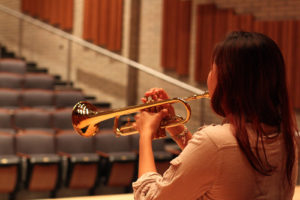
Trumpet-Audition-1

For several years I’ve given audition workshops aimed at high school and college students, and it’s finally dawned on me to share my accrued wisdom on the topic. Here are some helpful tips for auditioning – be it for a college, a youth orchestra, a school program, or even a professional job – that may be of interest.

Before launching into the laundry list, I’ll give my most important piece of advice: Do not let the results of a single audition affect your self confidence or self worth! Remember that the judges are on your side – they want to fill their studios/programs/orchestras/bands with talented members, and they are hoping that you will be an excellent fit. They are not out to exclude you – they want you to succeed. Perform for them and they will be pleased.

What we’re listening for

Scales

  • A musical introduction. These should be fluent and accurate.
  • Aim for evenness of tone and accuracy of intonation.
  • Sometimes specific instructions on scale patterns/articulations will be included. Pay close attention to these.

Excerpts

  • Carefully consider tempo/metronome indications and dynamics.
  • Listen to several recordings of each piece.
  • Try to imagine the rest of the orchestra as you play your part.

Solos (Concerti, etc.)

  • Choose your repertoire wisely. I would much rather hear you play a piece you are very comfortable with at the height of your abilities rather than a piece that is too hard, or that you just began work on, played poorly.
  • Choose a work that has contrasting sections, or prepare a pair of excerpts that show fast technical work as well as lyrical musicality.

Sightreading

Don’t freak out, just prioritize:

  • 1. Pulse: if you make a mistake, don’t interrupt the pulse of the music – keep going so that the meter retains its shape. Pulse is like a conveyor belt that doesn’t stop.

https://www.youtube.com/watch?v=8NPzLBSBzPI

  • 2. Rhythm: even if the notes are giving you a problem, try to perform the rhythms accurately.
  • 3. Pitch: the notes themselves come next. Make sure you’ve memorized the key signature before you begin.
  • 4. Musicality: niceties of dynamics, articulation, and phrasing

Note that I’m not including tempo on this list of priorities. In most cases, it is not important that you play the sightreading at the marked tempo, though that would surely be a bonus. Judges would much rather hear an accurate rendition at a slower tempo than an inaccurate one at a faster tempo.

If you are allowed to choose your own tempo, read through the excerpt first and identify the fastest rhythms/trickiest passages. Determine a tempo at which you could comfortably play these sections and then imagine the music from the beginning with that tempo in mind.

Preparing for your audition

  • Seek advice and assistance from your teachers/mentors
  • Try to mimic the audition scenario. If you know what the audition room looks like, spend time visualizing it and imagining your audition in that space.
  • Mark your scores clearly for the accompanist (esp. singers) and judges.
  • The three electronic aids you should use in preparing for an audition (or for practicing more generally): metronome, tuner, recording device. These are all available on your smartphone.

On the day of your audition

  • Arrive early. Especially if you’re traveling for a college audition, plan for navigating a new city/mode of transportation; traffic; parking; walking from your car/train; navigating the campus/building; check-in; warm-up time; rest.
  • Dress appropriately, neither overly formal nor underdressed.
    • Make sure you can play in what you’re wearing
    • It never hurts to add a unique, but non-distracting touch to your wardrobe.
  • Go with the flow; schedules often run late.
  • Tune directly before entering the room.
  • Introduce yourself and your selections.
  • Be polite, but not familiar with the judges.
  • Have a positive attitude – perform!
  • Be prepared to be cut off, and do not let this effect your performance. Often this is just for time’s sake, to remain on schedule or get caught up.

After the audition

  • I repeat: do not let the results of a single audition affect your self-confidence or self-worth!
  • Some auditions will offer you feedback. If this is offered, use it as a valuable opportunity.
Things such as I have learned about the string bass in recent times

I’ve recently made the acquaintance of a very interesting young artist in Portland, OR, one William Gibbs, bass player by trade, who has taught me about a very interesting practice engaged in by a very slim number of bass players. Namely, tuning in fifths.

Theses players tune their basses exactly as cellos, an octave lower: C-G-D-A. Will’s assertion is that it allows for much more accurate tuning with the orchestra’s cello section (which of course makes perfect sense) and what’s more that it gives a more articulate response on the instrument all around.

We also talked about other tuning systems for the bass, like the D Major or so-called ‘Viennese tuning’, which is demonstrated by my former colleague Owen Lee here:

This is obviously a gag, but to hear the tuning played properly, Owen made another video which you can view here.

Now, Owen claims that this is the way basses were tuned in the classical era of Mozart and Haydn, but Mr. Gibbs complicated this view for me a bit, and told me that bass players historically used a wide variety of tunings, often tuning their instruments to the piece they were playing. We tend to think of low Cs as simply a matter of having an extension or a fifth string, but the idea that bassists would have treated their instruments almost like transposing instruments clarifies a great deal, particularly about the Beethoven symphonies (the 5th and 6th in particular).

Usually I just can’t with all this bass stuff. Bassists tend to be REALLY into bass to the exclusion of all else, and it’s just too bass for me, but this tuning in 5ths is something that I’m really convinced by and I think needs wider mention. I imagine learning it would be like converting from a QWERTY to a DVORAK keyboard, but if certain intrepid bass players would give it a shot, maybe we could get a good sample of data and see if it’s really worth the effort.

This is definitely going on my agenda when I convene the World Association of Musicians, along with converting the double horn from a transposing instrument in F to a non-transposing instrument reading alto clef, deciding the ultimate meaning of the tenuto, and rendering official once and for all the status of the ‘unaccented mark’.

Doings

This summer, two of my new bébés shall be ushered into the world:

Monday, June 13, 7:30 pm
The Dwarf Planets: Band Edition (premiere)
Baldwin High School Wind Symphony
Adelphi University, Garden City, NY

Really looking forward to this one. The concert features new works by SIX composers, including Paul Moravec, whom I consider to be something of a celebrity. Major props to by boy Scott Dunn for his efforts in commissioning and promoting new music. I’ve worked with his students before and I’m really looking forward to doing it again. I’ll be on hand to conduct.

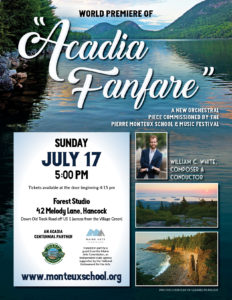
Sunday, July 17, 5:00 pm
Acadia Fanfare, world premiere
The Pierre Monteux School, Hancock, ME

Acadia Fanfare Poster - small

The Monteux School is really home for me, the place where I learned so much of what I use in my music-making every single day, and I feel privileged to give back with a new piece for orchestra that celebrates the school and the natural beauty of Acadia National Park. I’ll be there the whole week leading up to this, and Monday, July 11, we’ll also do “The Itsy Bitsy Spider“.

IN BETWEEN: I go to China for 11 days with Metropolitan Youth Symphony to cap off my season as their Interim Music Director. I’ve never been to China before, but I’ve been taking Chinese lessons for the past 10 months and I’m boldly going to attempt giving my concert speeches there in Chinese (你门好, 我叫白威廉!) which I think will come off as charming if not intelligible.

ALSO: I will, at some point, recommence making “Ask A Maestro” videos. I have sooo many great topics: How does a composer know when a piece is finished? What jobs can a musician do? How do you know what key a piece is in?

I also want to do a lightning round video at some point where I just answer a bunch of short questions about classical music, so if you have any little ones or big ones or anything in between, you can always submit them on the Ask A Maestro tab above.

The Jungle Book

I haven’t seen the new Jungle Book, and I’m not going to, because I’ve listened to the soundtrack, and it sucks.

Specifically, it sucks in comparison to the soundtrack from the 1967 animated version, which I think is Disney’s best, both in terms of songs and score:

The music in the current soundtrack about as bland a generic Hollywood action score as I could imagine. It’s competent, but where are the spices of the orient? Where those trilllzzz at? Where those Randall Thompson strungs at?? Where the hell is the alto flute doubling low-register clarinet mixed with some dope-ass muted hornzz???

Now we just get a little Zimmer here, a little Horner there, and a whiff of Elfman to tie it all together. Nary an attempt is made to place the action in India, and that was a real opportunity to improve on the ’67 version which employed only a vague (though delicious) brand of Orientalism.

The current score sounds more like “Colors of the  Wind” meets “Lion King” meets “Titanic”. Why not incorporate some Indian tablas or a spicy sitar lick? Or perhaps something reminiscent of Elgar and empire? I know I’ve made this complaint before, but why oh why can’t we have film scores that contribute to the movie’s setting?

Luckily, I can do more than bemoan bad Jungle Book music in this post, because I’ve just discovered a new (old) composer: Charles Koechlin. You want Jungle Book music? Baby, you got it.

Koechlin was a wildly prolific, long-lived (1867-1950) French composer who was obsessed with Rudyard Kipling in general and The Jungle Book in particular. His music is a fascinating mixture of French Impressionism, Scriabinian eccentricity, and an almost Webern-esque exquisiteness, and the whole adds up to way more than the sum of its parts.

He wrote gobs and gobs of music, and I’ve just bitten in, but I haven’t yet to be disappointed. After you finish with the Jungle Book music (of which there is more) I’d direct your attention to Les Heures persanes. He also wrote an orchestration treatise which is said to be among the most complete treatments of the subject, so I’ll get back to you on that once I can track one down.

Isn’t it fun having a new composer in your life??

Thy King Cometh: 10 year anniversary

Today is Easter, and it happens to be Easter of the year 2016, meaning that this is the 10 year anniversary of my first large-scale professional work, an oratorio called Thy King Cometh. It’s a Purcell meets Sibelius meets Vivaldi meets Ravel kind of Broadway fantasy on Easter themes (well, there’s a Christmas section too, but if you click on the video above, it will start right at the Holy Week stuff.)

I wrote this piece to be performed by the massed musical forces of a little church in the exurbs of Chicago during Holy Week in 2006. I was working as their interim choir director on something like an 8-month contract. Looking back, it shocks me to the point of absurdity that the church’s leadership didn’t bat an eyelid when I told them that I would be composing ALL THE MUSIC for their highest-profile services of the year.

What’s even more galling is how uniquely unqualified I was to write this piece. I knew a little about choral literature, but I was not, as they say, a churched member of the populace. I had just graduated college with a liberal arts degree from, let’s admit it, an overly cerebral university music department. My senior year was spent bathing in Schnittke, Ligeti, and Berio, and I had been banking on going straight into grad school for orchestral conducting.

I didn’t end up getting accepted to any of the masters’ degree programs that I’d applied to, and in many ways this was my first major brush with rejection (hardly my last). In retrospect, I’m glad that it happened right out of the gate, because it forced me to figure out what artistic aims really were as opposed to my career ambitions.

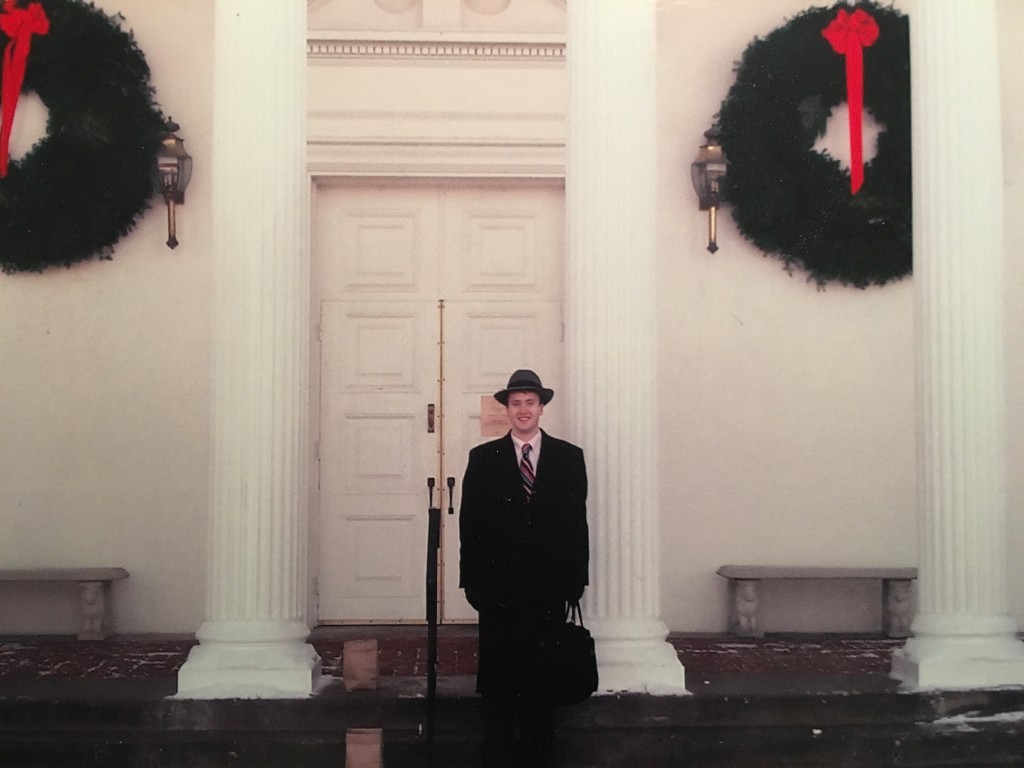
I think I was pretty pleased with myself for landing an actual job though, even my appointment was arranged very ad hoc when a colleague/teacher of mine had to leave on short notice. I actually made a decent little salary and I delighted in being the Golden Boy Choir Director, dressed to the nines every Sunday morning complete with gloves and hat.

image1

But beneath the pastel shirts, I was your typical post-collegiate mess: I was depressed about the grad school thing, I still lived near my old campus, and I spent way, WAY too many nights playing saloon songs in my friend Tim’s frat house basement, cigarette in one hand, whiskey in the other. I have a vivid memory of one Sunday morning when I had to RUN out of the choir loft to the bathroom to kneel before the porcelain altar (“food poisoning”, dontcha know?)

I spake as a child, I understood as a child, I thought as a child: but it was time for me to become a man and put away childish things.

I realize now that setting myself the inordinate task of writing so much music in such a short time was my way of accepting the responsibility of my passion for music. It meant that I would honor my relationship with music no matter what the circumstances and better myself as a person to devote myself as fully as possible to that relationship.

And so I got down to business. Many nights I slept on the floor of my office, using the handbell pads for a mattress. I researched theology, biblical history, old and new testament scripture. I cranked out movement after movement, each with a slightly different instrumentation and style, which was another big part of why this piece contributed so significantly to my development as a composer: each piece was a self-contained experiment.

I still love this music, and if I’m being honest, I think the best piece I’ve ever written is the little movement for strings and women’s choir, “And the Lord shall Deliver me” (43:04 above). But the big hits are “Crucify Him” (“Jesus on Trial”), “Thanks be to God!” and of course “Hosanna” (aka “The Triumphal Entry”; watch the 2007 recording session below:)

I’m happy to report these still get performed in churches on a fairly regular basis, and one day I hope to rescore the whole blessed thing for full orchestra.

Also, see that shirt I was wearing in the recording session? It was my favorite. I LOVED that shirt.

fff

fff

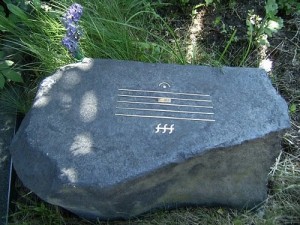
ClassicFM posted a photo of Alfred Schnittke’s gravestone on Facebook today. I wrote a thing about it for Brandon Wilner’s fakemusic.org in 2015. Here is a lightly edited version (doesn’t one’s prose always looks worse in hindsight?)

The Soviet composer Alfred Schnittke lived from 1934 to 1998. He was buried in Moscow; his grave is marked with a simple stone, upon which is inscribed a peculiar marking: a whole rest topped by a fermata, marked fff.

The rest indicates silence, emptiness, the absence of sound. This particular rest is a ‘whole rest’: it indicates a silence for the duration of the full bar. Above the rest sits a fermata, Italian for ‘stop’; it’s shaped like a sideways crescent surrounding a dot. In musical notation, a fermata above a note indicates that the note should be held for an indeterminate length of time. (In an orchestral work, the players would watch the conductor in order to cut off the note together).

Taken altogether then, this notation describes a long silence of indefinite measure: the never-ending sleep of the dead rendered in standard Western musical notation.

There is one additional element though, which stands in a contradiction to the above: the three f’s below the whole rest stand for the Italian fortississimo, very, very strong. This is the loudest dynamic marking regularly used in classical music.

We have at least two possible readings:

  1. That the absence of Alfred Schnittke leaves an excruciatingly loud silence in our world; the loss of his music is a painful maw.
  2. In spite of his corporeal disintegration, his spirit remains ever present, roaring, and emphatic through his music.

Because this musical marking indicates a ceaseless stream of silence, and because Alfred Schnittke cannot return to the realm of the living (though he did this very thing following his third stroke), Fake Music chooses not to reissue the work so as not to define the parameters of his—or his music’s—rest.

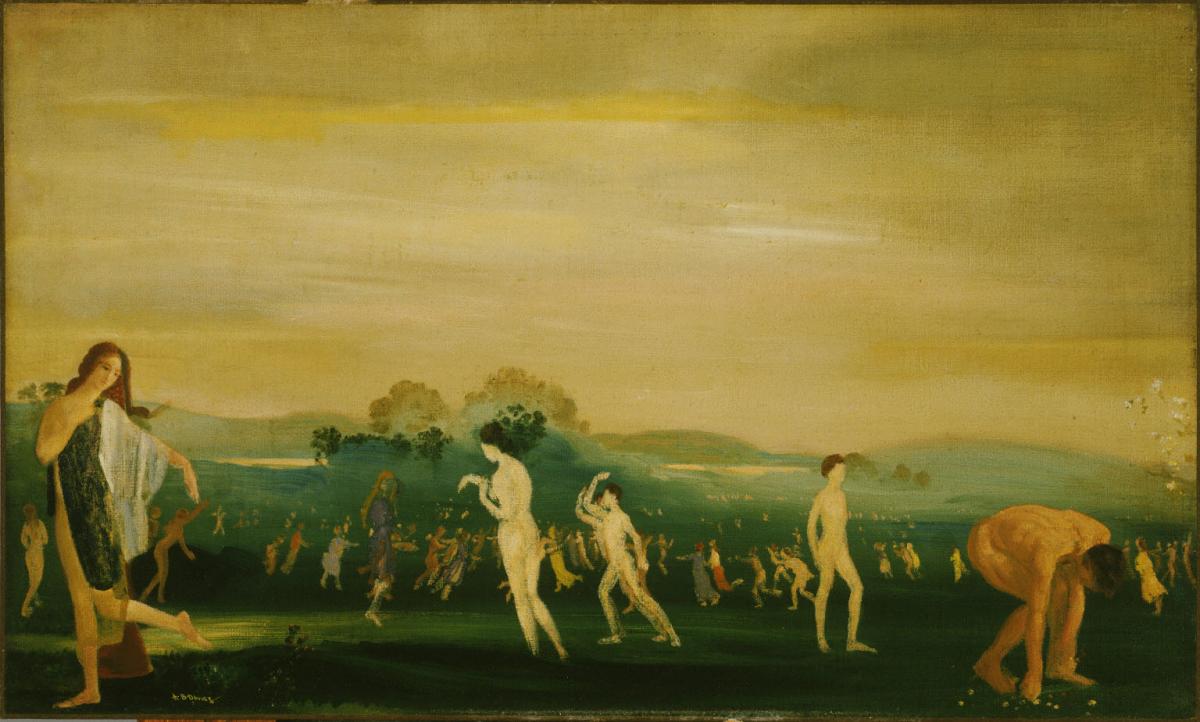
Elysium

Collection item 0439

I’m preparing to conduct Beethoven’s 9th (the last movement, anyway) and that’s brought me full circle in terms of my blogging, because in my very first blog post, I wrote about how obsessed I was with one particular marking in the score: “selon le caractère d’un Recitative mais, in tempo”. It’s a phrase so linguistically fluid it practically wipes right off the page, combining vocabulary, grammar, and spelling from French, Italian, and German, yet it would hardly raise an eyebrow from a properly trained classical musician anywhere in the world.

But now I’m obsessed with an even tinier detail of this score: the ‘y’ in the word “Elysium”. Y? Because we love you! And because I’ve got to figure out how the singers are going to pronounce it. People wonder what a conductor actually does. Well I’m here to tell you: she makes CHOICES honey.

In Modern German ‘y’ is pronounced ‘ü’, so if you listen to the first 12 of the video below, you’ll hear it pronounced “Tochter aus Elüsium”:

But here’s the thing: I’m not convinced this letter should really be a ‘y’ at all. (mic drop)

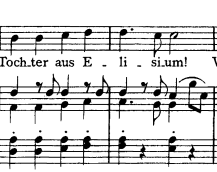
See, as I prepared this piece, I marked up a choral score for my colleagues, and I noticed this:

Screenshot 2016-02-27 07.54.06

Elisium! With an ‘i’! This I had never seen before in any edition of the score, but I was intrigued, because certainly a word spelled this way would properly be pronounced Eleesium, right?

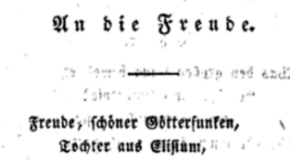
Now I had two questions: 1) how did Schiller (the poem’s author) spell it, and 2) how did Beethoven spell it? Here’s the printed page from Schiller’s collected works of 1812, Beethoven’s likeliest source for the text:

Screenshot 2016-02-27 17.21.48

And there, adorned in all it’s fraktural splendor, ‘Elisium’ is spelled with an ‘i’.

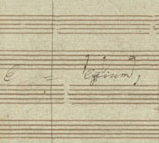
OK, but there’s still a discrepancy between the scores, so how in fact did Beethoven spell it? Well you can have a look at his original manuscript over at the Berlin State Library Archives, and if you can decipher his handwriting I think you’ll find there’s most definitely a ‘y’ in there:

Screenshot 2016-02-14 21.40.45

So Schiller spelled it ‘Elisium’, Beethoven spelled it ‘Elysium’ but either way, how do you pronounce it? Well, if history be any judge, I’d say it’s pronounced the ee way (or [i] for you IPA folks out there.) Certainly this is the traditional approach—listen, for example, to Joseph Krips’ recording:

In hopes of some historiographic confirmation though, I navigated over to the German Wikipedia article on the letter ‘y’ and found this bombshell:

Noch im früheren 19. Jahrhundert war hingegen die Aussprache [i] üblich.

(“However, the pronunciation [i] was still commonly used in the beginning of the 19th century.”)

So we can be pretty confident that El[i]sium would have been the pronunciation in Beethoven’s time, so much so that ‘i’ and ‘y’ were interchangeable.

But what gives? In every edition of the poem published during Beethoven’s lifetime, the word was spelled ‘Elisium’. Whereby and wherefore did the composer come to make the alter the poet’s orthography?

This remains a total mystery to me and I welcome any insights or information. Maybe I should set up a toll free hotline. My best guess is that someone in Beethoven’s circle brought to his attention that, as a Greek loanword, ‘Elysium’ would more customarily be transliterated with a ‘y’, as the German were (and are) in the habit of doing.

But clearly Beethoven decided to change the ‘i’ to a ‘y’, so I’ll admit, I do have a lingering doubt—why would he bother to change the spelling if he didn’t intend any actual effect on the sound?

And an even better question: why is there nothing written about this anywhere?? Google was NO help. Shouldn’t someone have written, like, a 30,000 word musicology dissertation on this by now? Or wait, did I just do that? I guess this is more like 300.

What’s this!?

What’s this? There’s color everywhere! What’s this? There’s white things in the air!

What’s this? The page scales when you change the size of the window!?

That’s right folks, it’s been seven years since the launch of www.willcwhite.com and let’s just say, granny was starting to show her age. So I called up my homegirl Stephanie Smith and hunty, she DID THIS.

Does it look super pretty? Of course it does. Does it have better fonts and graphics? Obviously. Does it stop there? No way, José. Here’s what Stephanie worked with her magical brand of wizardry:

  • E-commerce: you can now purchase scores & parts of my music in .pdf format directly from this website. I’m getting the pieces up bit by bit, so if there’s something you want but don’t see, leave a comment or send an e-mail. This all goes through PayPal. Go to the WORKS page to check it out.
  • Mobile compatibility. Because it’s 2016!
  • My upcoming appearances and events are now listed in the right sidebar.
  • I’ll be publishing a biannual e-mail newsletter that you can subscribe to.
  • Ask a Maestro has it’s own dedicated page where you can post a question.

There’s also just lots of other detailed information and updates that I’ve scattered throughout the site, so do explore. And tell Stephanie what an amazing job she did on all of this! How? I have no idea! Twitter’s not her jam, so, I don’t know, go to her SoundCloud page and write a bunch of nice stuff about her music (which is totally rad btw.)

Anyway, I’m loving my new place, and you’re welcome to drop by whenever you’d like. Kick your feet up, listen to some tunes! And remember what I said about being able to buy stuff here? Well don’t be bashful about that, cause this fancy new functionality don’t pay for itself!