What’s this!?

What’s this? There’s color everywhere! What’s this? There’s white things in the air!

What’s this? The page scales when you change the size of the window!?

That’s right folks, it’s been seven years since the launch of www.willcwhite.com and let’s just say, granny was starting to show her age. So I called up my homegirl Stephanie Smith and hunty, she DID THIS.

Does it look super pretty? Of course it does. Does it have better fonts and graphics? Obviously. Does it stop there? No way, José. Here’s what Stephanie worked with her magical brand of wizardry:

  • E-commerce: you can now purchase scores & parts of my music in .pdf format directly from this website. I’m getting the pieces up bit by bit, so if there’s something you want but don’t see, leave a comment or send an e-mail. This all goes through PayPal. Go to the WORKS page to check it out.
  • Mobile compatibility. Because it’s 2016!
  • My upcoming appearances and events are now listed in the right sidebar.
  • I’ll be publishing a biannual e-mail newsletter that you can subscribe to.
  • Ask a Maestro has it’s own dedicated page where you can post a question.

There’s also just lots of other detailed information and updates that I’ve scattered throughout the site, so do explore. And tell Stephanie what an amazing job she did on all of this! How? I have no idea! Twitter’s not her jam, so, I don’t know, go to her SoundCloud page and write a bunch of nice stuff about her music (which is totally rad btw.)

Anyway, I’m loving my new place, and you’re welcome to drop by whenever you’d like. Kick your feet up, listen to some tunes! And remember what I said about being able to buy stuff here? Well don’t be bashful about that, cause this fancy new functionality don’t pay for itself!

Moments musicaux

I went to something called a “Board Retreat” last week, during the course of which each person seated at the table was asked to recall a defining musical moment of his or her life.

I offered three short vignettes, which I thought showed admirable restraint on my part:

1. The late ’90’s, a performance of the Franck Symphony in D minor by the National Symphony Orchestra, conducted by Leonard Slatkin.

My mother took me to this concert, for which I have to give her all kinds of credit – she had little-to-no classical music background, but she willingly stoked the flames of my enthusiasm by purchasing us a yearly subscription to the Kennedy Center.

I had never heard (and probably never heard of) the Franck symphony before, and that’s the reason this performance made such an impression: it was the first time I listened to a new work all the way through and could track the themes like characters in a novel or play.

Franck’s ‘cyclical form’, in which themes reappear in all the movements of a symphony, became a major interest of mine, and it gave me a new view of the dramatic possibilities of instrumental music.

2. June 2004, my first day at the Pierre Monteux School, Hancock, ME.

On the first day of school each summer, the new students are asked to lead the orchestra through a standard repertoire work with which they are already familiar. I chose the last movement of Brahms’ 2nd symphony.

My instructions were to introduce myself, call the piece, and to say nothing more before giving the downbeat.

“My name is William White, and I will be conducting the last movement of Brahms’ 2nd. In two.”

“What did I tell you!?” came the reply from the maestro at the back of the orchestra.

*Terrified headlit-deer stare in return*

“I told you not to say anything.”

In 2. That’s what got me in trouble.

This might not sound like much, and it perhaps the rebuke wasn’t as gut-wrenchingly terrifying as I recall it having been. But when you’re 19, every experience has an added weight, because it’s your first, and I proceeded in abject terror.

Somehow I managed to get from the beginning to the end of the movement. This movement represents a few things to me: a) moments of adversity are when we have to rise to our best, b) it’s important to get knocked down a peg every once in a while, and c) we learn the most from our failures.

3. June 2015, Carnegie Hall. 

I took my CSYO kids to Carnegie Hall and played a Schnittke / Prokofiev / White program. The kids were like family, no one in the administration gave me crap about programming Schnittke, and I got to introduce my music at Carnegie Hall. Come on.

‘Tis the season

o-BEST-WORST-CHRISTMAS-MUSIC-facebook

My work asked me to make a holiday playlist and it’s pretty darn delightful, so here it is for you to enjoy (Spotify)

Anditionally, I’m reading Jan Swafford’s most excellent biography of Brahms right now, so I made a playlist with everything Brahms published in his lifetime, in the order in which it was published. This took freaking forever so I hope someone else will find it of use.

Finally, I feel it’s always worth mentioning that way back when, I wrote some tunes both Lenten and Natal. My favorites are a Magnificat in two movements for solo soprano and chamber orchestra:

And an anthem for choir, brass, organ & timpani, “Glory to God“:

Ho ho ho!

Composition lesson

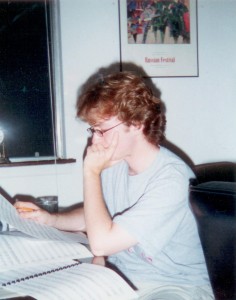
Me composing at age 19, i.e. 13 years ago, i.e. just kill me now.

Me composing at age 19, i.e. 13 years ago, i.e. just kill me now.

It recently dawned on me that I have now been composing music for TWENTY YEARS. I wrote my first piece for a 7th grade English assignment on “A Midsummer Night’s Dream”. I was 12 then. I’m 32 now.

I’ll spare you the psychological torment that’s accompanied this realization and instead offer you some advice from my two decades of experience:

Process

  • Think carefully about what you want your piece to depict / represent / express. For me, this is probably 75% of my time spent working on a piece.
  • Listen to your favorite pieces while reading along with the score. Don’t be afraid to imitate music by the composers you like. Eventually what is theirs will wear away and what is yours will remain. A composer’s language is the assembled residue of his many influences.
  • Establish the ‘ground rules’ early on in your piece. What is the basic style / musical language? Is this piece going to be full of surprises? Full of whimsy? Full of solemnity? Give the listener some idea early on.
  • Sometimes you’ll start off writing a piece following a certain “concept” (a theoretical approach, a program idea, a mathematical formula) and you’ll get to a part where your gut tells you to break the rules you’ve set up in order to achieve a more satisfying musical moment. Follow that instinct.
  • Don’t be afraid to throw out what’s not working. With each passing year, I grow more confident abandoning ideas that I may have been developing for days. The effort you put in will pay off somewhere down the line, and your piece will be much the better; there are always more ideas. That said, sometimes composing is a real slog.

Structure

  • Use patterns. If you want to surprise your listener with something odd, striking, or novel, it’s best accomplished by breaking an established pattern. Sudden changes in texture / style / patterning should be the exception, not the rule though.
  • Structure your piece so that the main climax comes towards the end of the work. In the classical era, this was often the end of the development / transition into the recapitulation. The climax is often the most dissonant moment. (See the golden ratio.) Consider very carefully the architecture of smaller climaxes leading up to your main one.
  • Fill the space. Look at a painting by a great artist or a film by a great director. Visual artists are keenly aware of managing the space in their frame and balancing all the parts. The same thing goes for musical textures. Think of each bar as a frame, a single shot, in your progression. Each beat, or the subdivision of each beat, is an area of the screen. Be very careful to balance the bar so that it is full. (See: Ravel, Dukas “La Peri”.) (But of course, not too full. See: Star Wars “Special Edition”.) The melody is like a character moving through the space.

Melody

  • Let every bar of every part ring with melody (see: Brahms, Debussy, et al.)
  • In traditional styles, the melody should have a fill at the end of a phrase (sort of a little melodic ‘tag’).
  • Very often the best melodies have one apex pitch – a highest (or lowest) pitch that is not repeated. Many composers save this pitch for the end (or towards the end) in order to give the melody a clear shape.
  • Melodic patterns that ascend by step are often very memorable (see: Richard Rodgers.) Stepwise patterning also breeds predictability, which gives you the opportunity to break the pattern and deliver a pleasant surprise.

Writing for musicians

  • For some reason, Richard Strauss got away with writing outlandishly demanding passages for his musicians and nobody batted an eyelash (well, maybe they did, but now they don’t.) You’re not Richard Strauss. Make your music challenging and interesting and even novel, but achievable.
  • Keep in mind that your musicians will be more engaged if they’re not sitting around for too long. That being said, when writing for orchestra or large ensemble, don’t include every instrument in every texture / passage. The orchestra has thousands of possibilities for chamber ensembles.
  • Create opportunities in which you are writing for people you know, and write for their particular skills and personalities. This will make your pieces more rewarding for everyone, and will keep your performers coming back for more.
  • Think too about the instruments you’ll be writing for. What makes them special / sound their best? What was their historical function? Try to structure your piece in some way around the instruments themselves.

Finally, I’ll just mention that I think the greatest compositional challenge is to write music for a solo instrument, especially an instrument capable of playing only one note at a time. Bach’s sonatas and partitas for the solo violin are about as good as it gets, but strictly speaking, we might say Debussy won this contest: