Posts Categorized: Posts

Memorandum

DATE: Monday, September 28, 2009
FROM: William White
TO: Mrs. M. J. S– and Her Merrie Band of Bowers
RE: Sibelius Second Symphony: Notes on the Markings

Dear Mrs. S– and Assorted Toilers of the Performing Ensembles Division,

Thank you so much for marking the string parts for my recital.  You will find that I have used many of the bowings already in the parts, and I hope this makes your jobs all that much easier.

As far as I can tell, there will be more erasing for you to do than marking.  Generally, I would like for the parts to be as clean as possible, within the bounds of reason.

Here are a few guidelines and helpful suggestions:

  • Please observe the instances where I have marked a bracket to indicate a subito dynamic level.
  • Please do mark my beat patterns (such as “in 3” or “in 4”), also circling them.
  • In certain cases, you may notice that I have erased one of my own bowings and written in a new one.  This is because I have come up with a better idea.
  • At the end of the fourth movement, please be sure to erase any mention in the parts of tremolo.  If a player has marked the beginning of this passage “measured” or “misurato”, by all means keep it.
  • You may come across such “colorful” notations as “Cotton Candy” or “Killer Bees” in the already marked parts.  These and other such marginalia are patently the scribblings of a depraved imagination.  Erase them with haste! Such hogwash is the antithesis of music and needn’t sully the minds of our fine student musicians.
  • Please do not erase any markings such as “Watch”, “Count”, or artistic renderings of tiny spectacles.  These are miniature gems, pearls of wisdom handed down to us from the past.  In fact, if you are feeling frisky, I would encourage you to sprinkle such helpful annotations at random in the parts.
  • I notice that the master copies have numbered measures and the other parts do not, despite the fact that they are obviously printings of the same plates.  If the additional parts are not numbered, I would very much appreciate it if you could number them.  This shouldn’t be an untenably large task, since you can merely copy the numbers at the beginning of each line of music from the masters.  In the case of the ‘Cello master, I have numbered the part myself.
  • Finally, allow me a short rumination on the philosophy of marking parts: I feel that parts should be marked only to change, enhance, or render more specific what is already on the page; never merely to emphasize it.  As such, if you find a part that is overly laden with circlings of dynamics, I would bid you please tidy them up.  After all, what does a circled dynamic indicate?  That this particular dynamic should be followed while the rest are ignored?  Perish the thought.  We must encourage our players to follow the printed instructions on the page, interpreting them with taste and care for the musical context.  I myself have been known to passive-aggressively erase such markings by my stand partners, immediately after they finish writing them, much to their consternation and annoyance.  Let’s try to avoid such situations by presenting the parts free of useless clutter.  Once again, I thank you.
Wrap-up

Well, the results of the highly acclaimed “Orchestra” poll are in, and here are the scores:

Lenny: 4 votes

Larry David: 2 votes

Charlie Rose: 2 votes

Nelson Riddle: 1 vote

Aaron Copland: 1 vote

Loren Maazel: 1 vote

These tallies are rather liberal, in that I assigned a vote to any mention of a participant”s name in a response.

So, kudos to Leonard Bernstein on this posthumous honor.  I must say I was a bit surprised… I thought Loren Maazel was a shoe-in.  But how can you go wrong with LB?  What”s my opinion, you ask?  Well, some of you thought that I had in fact cast the first vote, but the initial comment, authored by a putative “will” was not me, but my friend Benjamin “William” Slocòmbé.  I personally agree 100% with my other good friend Eric “El Bensòn” L. Benson, who prefers the particularly mellifluous yet syllablically daring rendering of Aaron Copland.  He also notes, quite correctly, that Larry David”s rendition bares a striking resemblance to the Copland.  So, I would say that Eric is also a winner in this contest.

Speaking of El Bensòn, you should totally check out his new blog: Inverted Garden.

In other news, Vincent Turner, aka. FrankMusik”s album “Complete Me” is now available this side of the pond.

Also, if you like FrankMusik, there is a slight chance you might like Tayisha Busay. (Although I”d recommend skipping the first track on their myspace player.)

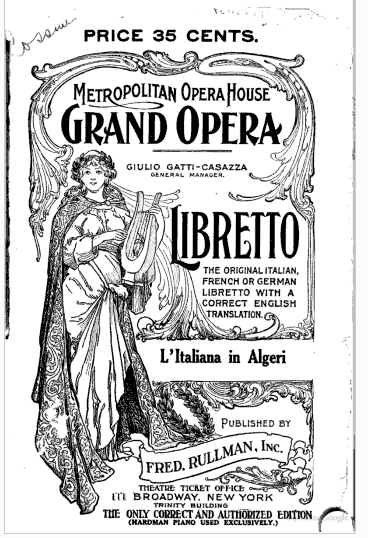
As for me, I spent this past week hunkered down in a pit playing cembalo for IU”s production of “L”Italiana in Algeri”.  Playing cembalo so damn fun, every night offering new opportunities for improvised audacity.  This Sunday, I play my “3 Waltz Scenes” at a small student concert, a very thrown together affair.  We”ll see how it stands up…

Orchestra

Americans used to have the most marvelous way of saying the word “orchestra”, somewhere in between “awchestra” and “ohchestra”.  It had a vaguely patrician ring to it and yet it was entirely of the people.  I don’t think it was a regional pronunciation, although New Yorkers and Bostonites certainly pronounced that way, as did everyone in the movies.

Now it’s time for a reader vote.  I’ve amassed a small collection of 20th and 21st century personalities, all Americans, saying “orchestra”.  Included are some notable hangers-on to the old tradition.  Whose version of the word “orchestra” do you like the best?  Leave your vote in the comments section!

Aaron Copland https://www.willcwhite.com/audio/aaron%20copland.mp3

Perhaps the finest representative version of the old-style way of saying “orchestra”.  Quite pleasant and mellifluous.

Frank Sinatra https://www.willcwhite.com/audio/aaron%20copland.mp3

Surprisingly, this is a pretty modern rendition, although I’m quite sure that if I did a little more digging, I would find Frank saying “orchestra” with more of the original flavor to it.

Nelson Riddle https://www.willcwhite.com/audio/aaron%20copland.mp3

Again, somewhere in the middle, but closer to the modern way.

Loren Maazel https://www.willcwhite.com/audio/aaron%20copland.mp3

A very classic, very patrician reading, for a very classic, very patrician sort of man. [His “Nawth Korean” ain’t bad either.]

Elmer Bernstein https://www.willcwhite.com/audio/aaron%20copland.mp3

Elmer “No Relation” Bernstein falls slightly on the classic side of the dividing line.

Charlie Rose https://www.willcwhite.com/audio/aaron%20copland.mp3

For me, Charlie has about the best rendition of “orchestra” of anyone under 70.  An interview between him and Loren Maazel is a match made in heaven and a symphony of syllables when it comes to this word.

Lenny https://www.willcwhite.com/audio/aaron%20copland.mp3

Lenny’s version is definitely in the classic category, though there are plenty of examples of him saying “orchestra” that have a more modern twist.  This particular version leans heavily on the “ohchestra” side of things and has a vaguely British quality to it.

Larry David https://www.willcwhite.com/audio/aaron%20copland.mp3

Larry David’s version is a fascinating one — his “awk” is very purely classic, and he really breaks up the rest of the syllables.

I really think that a revolution is afoot and that we can get the word “orchestra” back to being pronounced the way it ought to be. It is our American birthright.

So, please do leave a comment about who says “orchestra” your favorite way, and which way might work best for you!

Tovey conducts rare “The Warriors” at the Hollywood Bowl

Bumping into that headline recently, I had to wonder: should Bramwell Tovey really be challenging David Patrick Kelly’s legendary interpretation of “The Warriors”?  I mean, come on – it’s iconic:

But perhaps I’m not a qualified judge — I mean I thought I knew that piece, but I didn’t even realize it was by Percy Grainger! I think Mark Swed really brings some interesting things to light in his article:

“The Warriors” was Grainger’s largest score, both in length and size of forces.

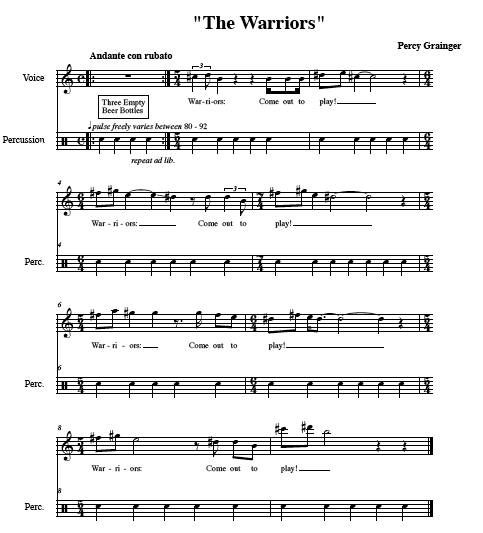
Haven’t we all aspired to writing for such magisterial forces as three beer bottles and a high tenor? [Editor’s note: nah…]

Completed in 1916, “The Warriors” has passages as rhythmically bold as Stravinsky’s “Rite of Spring,” which premiered three years earlier.

To wit:

Picture 1

Mwa ha ha ha… I kill me.

But seriously, you can get a recording of the actual piece here.  It’s definitely a capital c C-razy piece of music if ever there was one.  More from Swed:

“The Warriors” divides devout Graingerites. Some find it an embarrassment. Others consider it his greatest masterpiece.

OK, I don’t know what to say about all that, except that “devout Graingerites” find “The Warriors” an embarrassment?? Isn’t it embarrassing enough that their idol was a crazy Australian S&M freak who kept categorical records of the whips that he used to flagellate himself? Not to mention an Aryan supremacist?  Nope, it’s THIS that embarrasses them:

https://www.willcwhite.com/audio/warriors%20clip%20edit.mp3
All I’m saying is, Priorities, people.

From chimpan-A to chimpan-Z

ctop1

In hard-hitting news that I am 100% not making up, the Canadian National Post reports on a story about a U.S. “scientist” from UW-Madison who has been conducting research on what kind of music monkeys are into. From the article:

Two university professors in the United States sought to find out whether monkeys would appreciate 30-second clips of music specially created for them more than popular music created for human listeners. Previous studies have found that monkeys prefer silence to any human music with a tempo, including German techno songs and Russian lullabies.

Frankly I think most sentient species prefer silence to German techno songs and Russian lullabies, but this gets better:

The human versions of songs used in the experiment included 30-second clips from Samuel Barber’s Adagio for Strings, Metallica’s Of Wolf and Man and Tool’s The Grudge. Researchers studied their responses for five minutes after each song played.

While Metallica and Tool were used as examples of music humans find arousing, the monkeys found the crunchy guitar chords calming. Eating, grooming, and engaging were indications the monkeys were relaxed.

Fair enough.  In fact, the monkey at the top of this post looks like he might have spent the better part of the 80’s rocking out to Metallica, maybe a little too hard — if you know what I mean.  The article goes on to explain, however, that the putative UW-M “researcher” collaborated with his friend David Teie, a cellist in the National Symphony Orchestra, to create music specifically designed for the monkeys’ enjoyment.  Here is the first clip:

https://www.willcwhite.com/audio/Monkey%20music%202.mp3
which I believe was meant to inspire some sort of simian George Crumb-Merce Cunningham collaboration.

OK, there’s no way to prepare you the second piece of music for the monkeys:

https://www.willcwhite.com/audio/Monkey%20music%202.mp3
And again, I am totally not making any of this up.  About the monkey music, the article goes on to say:

When the primates heard the monkey versions of both songs, on the other hand, they reacted as the researchers predicted they would. The monkeys urinated, shook their heads and stretched, indicating an increased state of arousal.

Funny, I did the exact same thing after hearing that last clip.

In the name of science, I would like to suggest a slightly different program for the monkeys, one sure to gain their undivided attention:

https://www.willcwhite.com/audio/Monkey%20music%202.mp3

https://www.willcwhite.com/audio/Monkey%20music%202.mp3

smiling monkey

Learn Conversational Italian through Rossini!

In Just a Few Easy Lessons!

LESSON 1 – Repeat after me:

Chi è costei?
Who is she?

È mia nipote.
She is my niece.

Di qual paese?
What country are you from?

Di Livorno ambedue.
We are both from Livorno.

Ah! non so dal piacer dove io mi sia. D’un’Italiana appunto ha gran voglia il Bey. Sarete la stella, lo splendor del suo serraglio.
Ah! My joy has quite unmanned me. The Bey longs for an Italian woman to be his favorite, and thou wilt be the star and splendor of his Seraglio.

Picture 1

Critical Commentary

Fanfare Magazine’s review of the American Chorale Premieres CD has just come out, penned by one Jerry Dubins.  It’s not much of a review, and I’m guessing that very few people will actually read it outside of the Cedille Records administration and Choral Music Junkies (if such things actually exist), but I simply must take issue with Mr. Dubins’ overall critical approach.

First off, let me just say that this is not an argument against his “review” of my piece.  In fact, he doesn’t really review my piece as much as offer a vague and vaguely dismissive semi-description of the music sprinkled with biographical misinformation (I’m well known in the Roman Catholic community?  For my choral music?  When did that happen?)  Since he doesn’t even attempt to figure out what my piece is about compositionally, there’s not much that I can respond to.

Where I really take issue is with his review of Egon Cohen’s Stabat Mater.  In the interest of full disclosure, I do know Egon, as we were both students of Easley Blackwood at the same time, and I would list him as an acquaintance – not exactly someone I would rush to defend under most circumstances.  I do quite like his piece on this disc, but that’s neither here nor there.  Here’s what Mr. Dubins had to say:

Finally we come to Egon Cohen (b. 1984), the youngster among this assembly. His Latin-titled Stabat mater set in English translation was written in response to an invitation to submit a piece for this CD. The music effectively captures the doloroso character of the text; but it does give me cause to wonder why a young, Jewish composer would be drawn to this deeply Roman Catholic 13th-century sequence that meditates on the suffering of the Virgin Mary. Surely, as Rochberg and many other Jewish composers have, Cohen might have found an equally moving text from the Hebrew liturgy.

Um, Excuse Me? You wonder why he couldn’t find a Hebrew text?  That so clearly falls into the category of None of Your Goddamn Business.  Would Mr. Dubins conclude a review of Mendelssohn’s Christus by asking the same question?  How about Max Bruch’s Kol Nidrei?  How about John Adams’ A Flowering Tree, for that matter?  Any critic who can’t understand that a composer might possess a vivid enough imagination to think outside of his closest cultural boundaries is truly wanting and kind of missing the point of a vast swath of artistic output.

I have no way of knowing if this Jerry Dubins is himself Jewish, and is perhaps a Yenta-ish figure of some sort, bemoaning the fact that a member of his tribe couldn’t meet a “nice Jewish text”.  Even in that case, I don’t really think that a music criticism magazine is the best venue for such an opinion.

Call me crazy, but I kind of think it’s a critic’s job to get inside the piece, whether or not it be his cup of tea.  David Effron, my conducting teacher, tells us that it’s our job to love any piece of music that we’re conducting.  Well, clearly it’s not the critic’s obligation to love everything he reviews, but I do think that a decent critic loves the process of delving in deep and trying to take a piece on it’s own terms.

This is where so many of the critiques of Inglourious Basterds go wrong.  I’d say about 90% of the reviews fail to penetrate the surface, or at least the immediate sub-surface level, even some of the more sophisticated ones.  For example, take Stephen Rea’s review in the Philadelphia Inquirer:

Tonally schizoid and rife with anachronisms (a David Bowie song on the sound track, out-of-era vernacular), Tarantino’s Third Reich folly is utterly exasperating.

Umm… “rife with anachronisms” is as far as you got?  OK, fine, this is a particularly shallow analysis, but most of the reviews don’t get past listing the many genre references that pervade the film.  Almost none of the reviewers get to the heart of how QT uses the genres artistically.  To me, the Big, majorly subversive element of the film [oh, btw, spoilers a’plenty follow] is not so much QT’s re-writing of history, but in how this interacts with our pre-conditioned genre expectations.  Because of films from The Longest Day right up through Saving Private Ryan, we the viewers damn well expect realism from the WWII genre — it’s almost like an unwritten moral code.  Even in more fictional WWII films, the details of an individual squadron or battle or whatever may be made up, but the outcome is always the same.

Tarantino absolutely knows this, and that’s why the third act of his film has tension — because the viewer is sitting there wondering “How is this plot going to fail?“.  Now, the problem is that that’s really the only reason why the third act has tension — there’s very little internal to the movie to make you yearn for the success of the grueling finale.  Within the film, the American “Basterds” are depicted as way more brutal than any of the Nazis, and the character of Hitler is imbued with a Mel Brooks-esque buffoonery; Tarantino is relying completely on the viewer’s personal sense of history to justify his (Tarantino’s) violent end to the Third Reich.

I’ve got a feeling that there might be a much, much deeper message here, that Inglourious Basterds is an Anti War Film – that is, both an Anti-War Film and an Anti War-Film, if you know what I mean.

So Jerry, what’d you think of the movie?

At the Movies

rebelscreen

About four months ago, I saw Giant (both the movie and the musical) and it dawned upon me that I hadn’t seen James Dean’s other two movies, East of Eden and Rebel Without a Cause.  Over the past couple days, I have filled in this cinematic lacuna.

I can dispatch with Eden pretty quickly by referring to Dan Callahan’s review at Slant Magazine (except I’m sure that Mr. Callahan meant to refer to Leonard Rosenman’s painfully overt score as “pseudo-Schoenberg” rather than “pseudo-Stravinsky“).  He’s got it all right – Dean acts like an overwrought Brando impersonator, Kazan’s direction is flaccid, and the story is reduced to a rather trite fable.

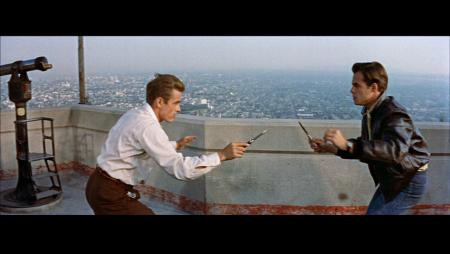
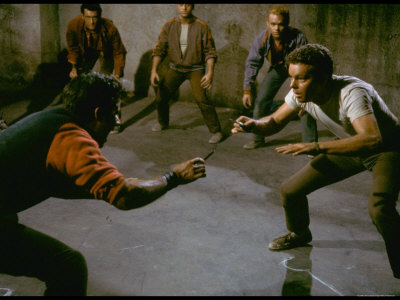
Then we come to Rebel Without a Cause.  Here, I’m perfectly willing to go along with Roger Ebert’s analysis, but we’ve got to take a step back on this one, because watching this movie brought me to a horrible, gut-wrenching realization: West Side Story is, in many respects, a Knock Off of this movie.

That’s sacrilege of the highest order, and something that pains me — PAINS me — to write, but there’s really no denying it.  OK, maybe “knock off” isn’t quite right, but WSS definitely owes a lot to Rebel.  Even, to a minor extent, the score. Sort of.

There, I said it… breathe deeply… BUT, the good thing is that whatever debts WSS owes to Rebel, it in every way improves upon its predecessor.  And obviously, Romeo and Juliet was the true model for West Side, but there are so many elements of Rebel that it’s impossible to ignore them.  I mean, Hello – Knife Fight? [See above.]

wss knife fight

As to what I said about the score, first off, Sondheim, thankfully, denies it.  And it may be wholly a coincidence given the subject matter and settings, but there’s no denying that this:

does sound in some ways like this:

Although upon further review, the latter possesses such a greater sophistication that the point is rendered almost moot.  Lenny’s score is a masterpiece and there are traces of everyone (“Hey, we’re having a party – why not invite the Black Panthers?”) so I guess it shouldn’t bother me too much that Rosenman has a small say in the dialogue.

Frankly I think very little prevents Rebel overall from being MST3K movie fodder… in fact, it largely resembles my absolute favorite episode thereof: “I Accuse My Parents“.

Speaking of movies, tonight is of course Inglourious Basterds night, and I’m definitely looking forward to it.  Quentin’s media saturation has reached monumental proportions even by his standards.  But it’s like, Quent, dawg, if you would just make movies a little more often, there wouldn’t be quite so much pressure on the success of the few that you do make.  I think, and I think most creative types would agree with me here, that it’s maybe the most important thing that an artist produce.  All the time.  Although there’s got to be some kind of limit to that, because even Stravinsky jumped the shark, and Lord Knows he was poppin’ ’em out all the time.

Speaking of which, I really ought to compose before taking in the cinema.

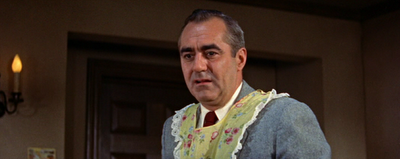
Oh, P.S. The trauma from my Rebel-WSS related psychoses was totally outweighed by the awesomeness of getting to see Mr. Howell in an apron!!

rebel-backus

Gotta Dance!

I’d like to share two recent discoveries:

1) You can have EVERY SONG like EVER from the 1930’s for 25 bucks on iTunes.  I shit thee not, people — 129 songs for $25.  Even if you’re only marginally interested in the top hits from the ’30’s, that’s still a helluva deal.  Highly recommended.

2) But what you can’t get on iTunes, for some blasted reason, is the totally amazing, English electro-pop musician FrankMusik whose music is seemingly the perfect mix of ’80’s, ’90’s and ’00’s dance music.  (Pardon my infomercial-speak).  Thank God for YouTube:

Let’s just hope it doesn’t take 70 years for him to get North American distribution.