Posts Categorized: Posts

Die heilige deutsche Kunst

I’ve just returned from a 9 day stint sampling the artistic delights of the city of Berlin.  My visit was a work/play combo, and I spent a good amount of time cooking up project ideas with my dear friend, the brilliant playwright Branden Jacobs-Jenkins, while also packing my schedule full of symphonic/operatic shows. [Speaking of Brandon, anyone in L.A. (as I will be next week) should totally go see his play this month (just click upon his linkèd name).]

I went to Berlin hoping to be disabused of all the usual rumors surrounding German classical music-making, but I’ve ended up finding them all to be true.  In no particular order:

1) German orchestras play with less technical precision but more gusto/musicality than their American counterparts.  True.  Although it’s not like they’re particularly lacking in the technical department either.  My first night in Berlin, I heard the Deutsches Symphonie, probably the second or third orchestra of the city of Berlin, but they played with a passion, beauty and energy that would outmatch many if not most of America’s top orchestras.  The piece was Verdi’s Requiem, the conductor James Conlon.  Hearing the orchestra of the Komische Oper play the score of Die Meistersinger a few days later was a similarly revelatory experience – the orchestra played with real command and gorgeous color under the direction of their new, young Chefdirigent, Patrick Lange.

2) The professional radio choirs of Northern Europe/Scandinavia* are the best around.

I had this choir director in college who was basically abhorrent in every way, and she would often ramble incessantly about the quality of the radio choirs in Berlin and Stockholm.  Well, the Rundfunkchor-Berlin was the resident choir for the Verdi Requiem that I heard, and they really were all that.  About half the size of a typical US Symphonic choir, they packed twice the punch, and you could really get a sense of each singer’s individual artistic contribution to the whole, but not in a distracting, sticking-out sort of way.

However, I do think that the Bach choir of Tokyo is maybe second best.  And I would never want to discount the recent achievements of Chicago’s own Grant Park Symphony Chorus.  But from my brief experience with the RFC-Berlin, I’d say this group combines the best of a large symphonic choir and a small chamber choir.

[*I’m just kind of assuming that the Swedish Radio Choir is really great in person too… their recordings are superb enough.]

3) The Berlin Philharmonic is the best orchestra in the world.

The particular concert that I attended really illustrates what makes this orchestra great.  The conductor was this guy, Tomáš Netopil,
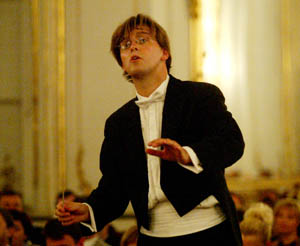
a young Czech conductor standing in for the not-so-recently deceased Sir Charles Mackerras.  He’s young, very energetic and makes music at a very high level, that’s for certain.  What’s not certain, though, is what to make of his interpretations.  The concert I heard contained two pieces: excerpts from Martinů’s opera Julliette and Dvořák’s Symphony No. 7.  I know very little about the Martinů repertoire in general except that I tend to really like his music and I always wonder why we don’t hear more of it on concert programs (my teacher recorded a bunch of his stuff though, which you should totally buy).

But I sure as hell do know Dvořák’s 7th, at least enough to say that Mr. Netopil’s was a very unusual interpretation.  One obvious point is that he used a totally different second movement, recently uncovered and edited by Jonathan Del Mar (who may be the most famous editor of classical music, assuming that such a thing actually exists.)  This new second movement was quite lovely, though it’s always jarring to hear a re-composition of something so very familiar.  My impression is that this alternate movement offers more in terms of color and fantasy but  lacks the formal tidiness of the movement we usually hear.

But I digress.  The thing about Mr. Netopil’s rendering of Dvořák’s 7th is that it was constantly on the brink – the tempi were generally quite fast but with lots and lots of modification, and he offered a gamut of surprises in terms of balance and color.  But I simply can’t judge it as an interpretation because the musicians of the orchestra made it work perfectly.  At times, it seemed as if the entire thing was going to disintegrate into a pile of mush — tempos would be pushed to such extremes that I didn’t know how the strings would possibly be able to play together, or how a particular wind player would conceivably be able to fit his rhythm into what the rest of the orchestra was doing.  And yet, they did it with aplomb.

There wasn’t anything the least bit casual about it even though it sounded totally natural; the orchestra played with more concentration and intensity than any other I have ever seen.  The furthest back players in all the string sections were as committed as the principals.  It was easily best orchestral performance I have ever attended.

[Caveat: the Vienna Philharmonic is a personal favorite, but it’s not exactly a normal orchestra – positions in the orchestra are handed down from father to son, they play these weird, ancient instruments that are not used by any other players in any other orchestra in the world, they supposedly mark their bowings in pen, etc…]

4) Eurotrash. Not so much an axiom as a word, but the opera productions I saw in Berlin (Meistersinger, Traviata, and a trio of abstract chamber operas by Boris Blacher) left much to be desired.  Many of you are probably familiar with the typical problems in German opera staging, and I should probably clarify my stance by saying that my argument is not with a particular aesthetic, but with the lazy attitude and sloppy work that accompanies most Eurotrash opera productions (it certainly applied to the ones that I saw.)

I fully understand that there are compelling reasons to update the costumes, sets and “concepts” of a given opera.  It makes sense that directors and designers should incorporate contemporary visual and artistic references into the operas they produce.  If the references are meaningful to audiences, the characters and dramatic situations in an opera can gain a vividness and relevance that might not be possible when staged traditionally.  Or maybe these visual touches bring out some previously undiscovered dimension to the piece.  And that’s great.  I recently went down to Bloomington to see the opening of IU’s opera season, a magnificent production of Barber of Seville directed by Nicholas Muni.  It had a kitschy, dark aesthetic to it and the costumes and set pieces really heightened the story-telling and comedy.

In Berlin, at the Komische Oper, however, all I saw was lazy, incompetent direction and design.  Every single cliché of the regietheater was on display: mirrors on the floors, exposed stage apparati, extraneous nudity, food being thrown, changed endings, etc. What I didn’t see was well-rounded characterization, thoughtful relationships, connections between words, music and drama, or anything that elucidated the action of the story with a modicum of interest.  Die Meistersinger von Nürnburg is a 5 1/2 hour long opera.  In the Komische Oper’s production, first two acts staged with costumes and sets exclusively in gray and brown.  That’s a rather monotonous color story for 3 1/2 hours of opera.  Then, in the third act, when the holiday festivities commence – what do you know?  Colors!  And this is supposed to qualify as an interesting artistic decision?  All I saw was a sucky collision of Dogville and The Wizard of Oz.

Then there’s the Traviata directed by this guy, Hans Neuenfels:
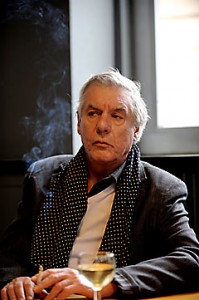
and even though I like basically everything about this picture of him, sitting through his production, I felt overwhelmingly that he should be drawn and quartered.  Let’s take as an example of his ‘craft’, his rendering of the character of Giorgio Germont.  This is really a complex character, a deeply religious man who asks Violetta, a woman he barely knows, to make an enormous personal sacrifice for the sake of his family.  What’s more, he feels a strongly paternal affection to Violetta upon meeting her.  So, wrapped into this character is a real conflict and a number of dimensions.  Here’s what he looked like in Mr. Neuenfels’ production:
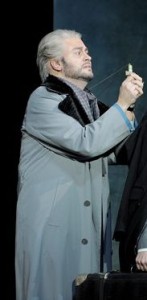
See how he’s thrusting his crucifix in other characters faces like a talisman?  That’s exactly what he spends about 90% of his stage time doing.  What you don’t see is his footwear, and the fact that one of his feet is cloven.  Cloven.  Like a goat.  Because, you see, religious people are really evil and hypocritical.  And it’s interesting and edgy to point that out.  Except when it’s not, which is like most of the time, but it’s particularly uninteresting in this opera.  Presenting this character in this light renders him way less interesting than a seated reading of the libretto would.

This post has sort of derailed, and I should point out that I loved Berlin and my experiences there, and my friend Branden is totally the best, but let me just end with this: Opera Directors, I hereby encourage you on behalf of whomever – let’s say the opera-going public – to work hard to re-invigorate constantly the operatic cannon with every production.  Dig deeply into the libretto and the score and try to access and interact with the combined intelligences of the librettist and the composer.   Create a bold interpretation and invite your audiences into a revelatory night of theater.  Please!!  It’s what we want.  But if you dig and dig and can’t find a way to express the piece and to express yourself through the piece, just don’t do it.  You know what?  YOU COULD EVEN WRITE YOUR OWN OPERA.  Go ahead!  It’s very hard work, let me assure you.  I just hope you aren’t frustrated by the efforts of your interpreters.

Season opener

I’ve kind of been stalking the Chicago Symphony recently.  Put another way, the orchestra has recently held three free events to open up their season, and I’ve been to all of them.  Two of them were hits – out of the ballpark we’re talking here – and one was a miss.

Thursday, Sept 16
Mexico 2010 celebrations
Benito Juarez High School Auditorium
Carlos Miguel Prieto, conductor

This event was part of the CSO’s contribution to Mexico’s bicentennial celebration, and important collaboration and outreach event given the large Mexican community in Chicago and given the fact that Chicago is a sister city with Mexico City.  The programming was awfully clunky though – why did it begin with “Till Eulenspiegel”?  Why not just, you know, Mexican music?  That’s what followed, namely Galindo’s “Sonnes de Mariachi”, Marquez’ “Danzon No. 2” and Moncayo’s “Huapango”.

Let’s forget this German oddball pink elephant gargantuatron in the room for a moment (which I’m guessing might have been the idea of the conductor who wanted to get something juicy into a rare appearance with the Chicago Symphony) and look at the Mexican selections.  I happen to have played all three of those pieces in orchestras at one point or another.  I’ve also played really, really good Mexican music.  If you were going to play Mexican music for an inter-generational, celebratory crowd, how could you possibly avoid doing Sensemayá, which is one of the baddest pieces of orchestral music Mexican or otherwise out there?

[part 2]

I’m basically just shocked that there was not a single piece by Ravueltas (above) or Carlos Chavez, who are justifiably considered Mexico’s great composers.  I also hate to rag on this concert because it did seem to deeply affect the community in attendance – young and old, Hispanic and non-, all seemed genuinely moved that their new auditorium would be graced by the presence of this great orchestra, and that’s a good thing.

Sunday, Sept 19
Free Concert for Chicago
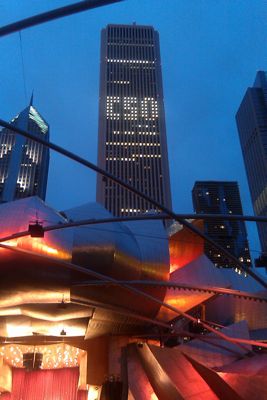
Millennium Park
Riccardo Muti, conductor

Here was an amazing concert – everything was just right.  First off, the orchestra sounded fantastic, like a real old orchestra with beautiful, singing tone.  A huge part of the equation was the programming, which was very much (and very wisely) of the “give them what they want to hear” variety: Verdi’s Overture to La Forza del Destino, Liszt’s “Les Préludes” (OK, nobody’s perfect), Tchaikovsky’s Romeo and Juliet, and Respighi’s The Pines of Rome.  All were appropriately flashy and bombastic, but for me, the Verdi stood out particularly in terms of sound and interpretation – just perfect.

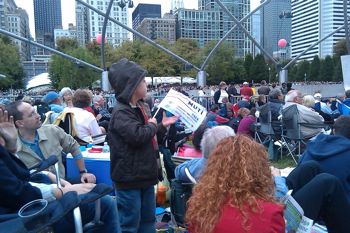
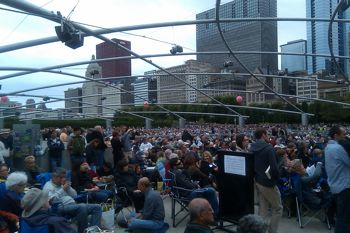
The other cool thing was how crowded it was there.  It literally felt like a rock concert wending one’s way through the unwashed masses at the park.

And at the end?  Fireworks!

Wed, Sept 22
Dress Rehearsal for the Opening Subscription Concert
Orchestra Hall
Riccardo Muti, conductor

Here were the real fireworks (umm… you know, figuratively speaking).  First half: Berlioz, Symphonie Fantastique.  Second half: Berlioz, Lélio.

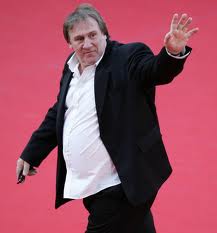
What is Lélio, you might ask?  Well, that’s a question easier asked than answered.  It’s the sequel to Symphonie Fantastique. [btw, I find the idea of a purely instrumental work having a “sequel” incredibly interesting – I can’t think of a single other example.  Can you?]  It’s a sort of monodrama for narrator, orchestra, chorus, and lieder singer with accompanist.  There’s a huge amount of dialogue given by the narrator (in Chicago played brilliantly by a truly corpulent Gérard Depardieu: )

The narrator is sort of Berlioz, but sort of not – basically, it’s whoever wrote the Symphony Fantastique – let’s call him Berlioz’s alter ego.  [p.s. here are some notes that I put up about Symphonie Fantastique a while ago.]  This has got to be the most Berlioz-y piece that Berlioz ever Berliozed, if you’ll pardon the expression.  Basically, the narrator extemporizes at length about his ordeal in composing/living the story of the Symphonie, the inability of his continental peers to understand Shakespeare’s brilliance, and his mental cohabitation with the characters from The Tempest – all interspersed with orchestral interludes, lieder played at the piano, and a choeur des ombres. Towards the end, it turns out that the composer-narrator just happens to have sketched a choral-orchestral fantasy on the subject of The Tempest, and – how convenient – there just happens to be an orchestra on stage.  Before the piece begins, he exhorts the players on stage to play in tune, follow the conductor, not to drag, etc.  This lengthier piece is what one usually hears from Lélio.  The “Tempest Fantasy” ends and the narrator is quite impressed and then goes off to die – or something.

Anyway, I’ve got to hand it to Muti – this is a hell of a way to kick off a season.  Great mix of a familiar classic and something crazy.  New York should be green with envy.  Their opening concert sounds like it SUCKED!!!!

Journey into the heart of dorkness

I recently listened to this concert, the 66th of the current Proms season, featuring the Berlin Phil with Simon Rattle in the following program:

Wagner, Parsifal Overture
Strauss, 4 Last Songs

… and then, played without any break:

Schoenberg, 5 Orchestral Pieces
Webern, 6 Orchestral Pieces
Berg, 3 Orchestral Pieces

[I should mention before we go any further that the audio from this particular concert is available for only another 12 hours (i.e. you won’t be able to listen to it after Friday morning.)  Sorry!]

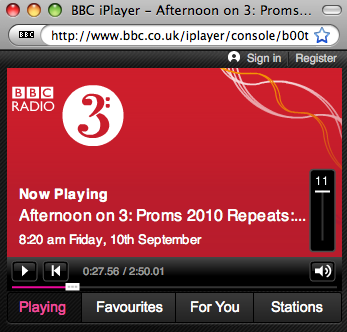
I think this is really a hell of a program, and certainly an interesting choice for a Prom, given that those programs usually tend toward the populist side of things.  But first off, if you end up listening to one of the Proms broadcasts on the BBC iPlayer, you’ll notice something a tad peculiar about the volume adjuster.  This has got to be a joke, right?

Or is their player really just louder?

My analytical juices started to flow when Sir Simon mentioned in his introductory remarks that the Parsifal Overture was in many ways the most rhythmically complicated piece on the program. This seemed like it might be kind of a stretch particularly because when you listen to it, it sounds like pure, unfettered melody with a subtle oscillation running underneath (like around 0:44).

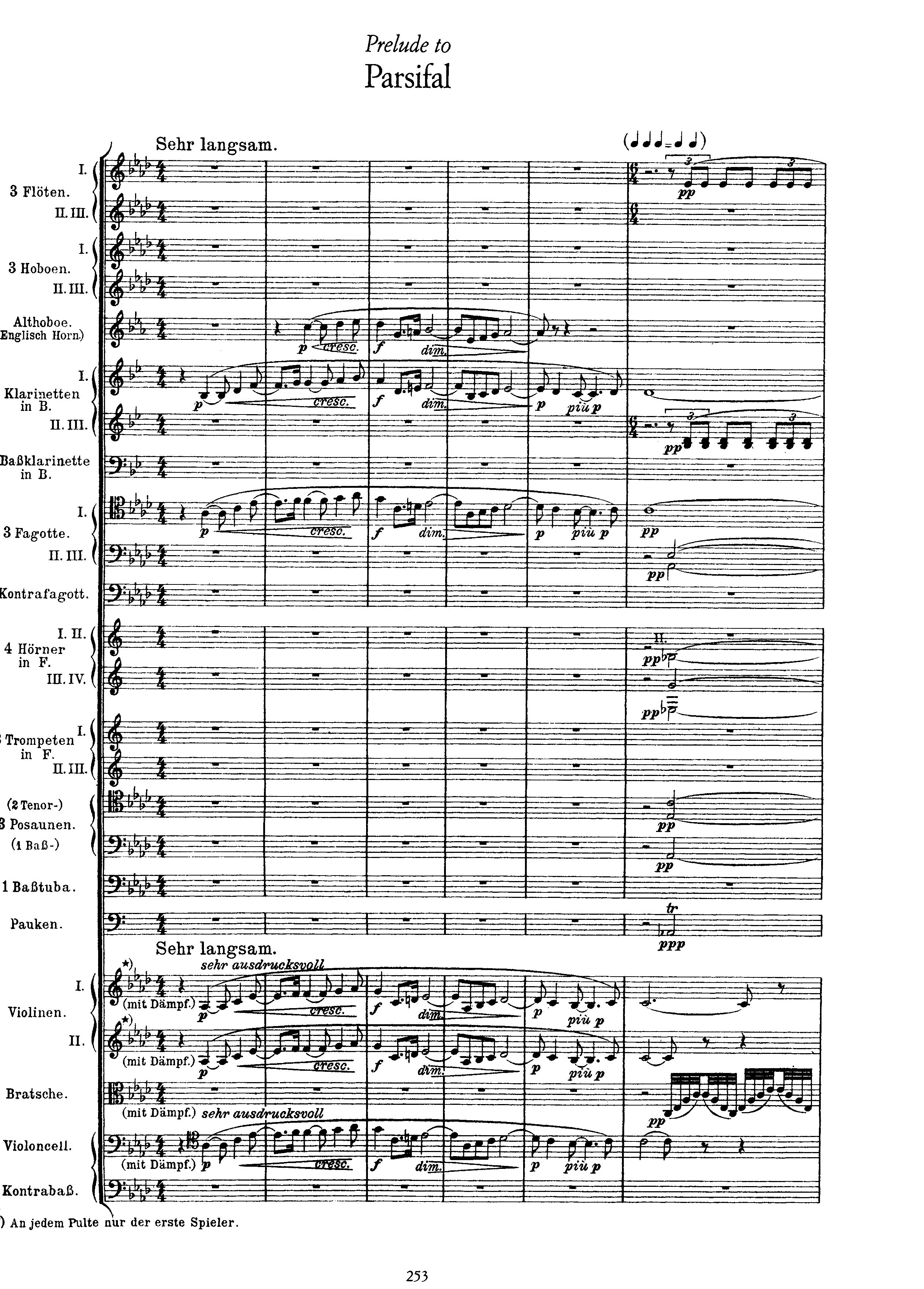
But not being familiar with the Overture (or is it a Prelude?) myself, I decided to take a look at the score:

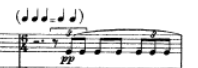
So now things start to get very interesting, because if you look at the flute part in the last bar, you see this:

which is one of these musical-mathematical conundra that conductors just love to stew over.  See, what happens is that while the rest of the orchestra keeps playing in 4/4 – i.e. four quarter notes per measure – the flutes and two of the clarinets have to count 6 quarter notes to each measure.  So, each of their quarter notes will end up being shorter/faster than the other players’ at a ratio of 6:4.

It would be easy enough if all they had to do was play 6 of their shorter, faster quarter notes against a conductor beating a four pattern of slightly slower quarter notes – musicians have to do this basic sort of trick all the time.  But Wagner doesn’t make it that easy.  Instead, he writes a rather complicated rhythmic figure (which, vexingly, will hardly even be heard in the orchestral texture.)

In this figure, the flutes and clarinets have to subdivide each of their six quarters into three triplet-eighth notes, so the total number of these notes in a bar is 6 x 3 = 18.  This is all well and good, lest we forget that their visual and musical reference in lining up with the rest of the orchestra is 4 (quarter notes to the measure, that is).  18 ÷ 4 = 4.5.  Since 4.5 isn’t a whole number, it’s not exactly useful.

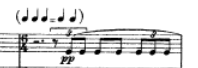
Except that a particularly clever flautist bent on finding a practical solution to this problem (the problem being how to know how fast to play her triplet-eighth notes in a bar of six and line that up with the conductor’s four pattern) might notice something: despite the fact that 4.5 seems to bear little logical relevance to the problem at hand, if we take a closer look at the particular rhythm that she’s playing:

we notice that the second beat in this pattern consists of 2 eighth notes.  So, one solution is to approximate the triplets and make sure that the second eighth lands on the conductor’s fourth beat.  1 eighth note = 1.5 of the triplets; therefore 3 triplets + 1 eighth equals 4.5 triplets.
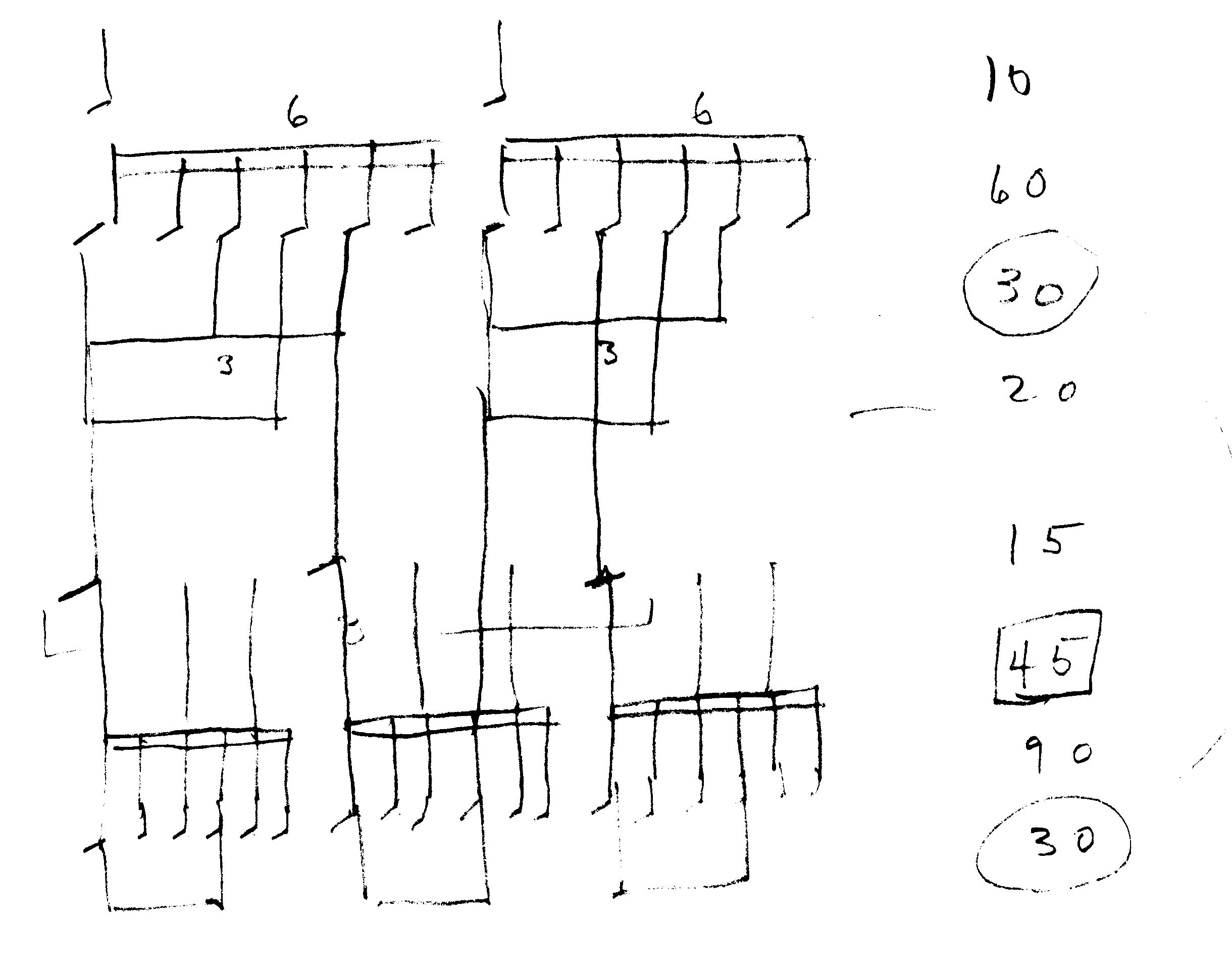

And that’s likely what everyone who actually plays this does, but the University of Chicagoan in me just hast to know the exact, theoretical answer, as practically untenable a solution as it may present.  The next step is to multiply the 18 triplet-eighth notes by 2 – basically, we’re looking for a least common multiple between 18 and 4, i.e. 36.

So then, the really anal-retentive flautist, who probably has no job and definitely has like zero friends, if she were hired to play the Parsifal Overture (Prelude?) would sit at home and practice counting 36 notes per bar (that’s 9 notes per beat, btw), and regroup those 36-lets into twos so that she would wind up with 18 groups of 2 and divide those 18 groups by 3 so that she could feel 6 beats per bar and know that she had done a really thorough job.  She might employ a chart that looked something like this:

and still not be quite satisfied with the outcome.  Now, if she really got to thinking smart, said flautist might decide to trip the conductor before he went on stage and step in for him, since beating a simple four pattern and letting everyone else worry about this crap is a way better idea.  But she wouldn’t be able to escape her obsession – her obsession with rhythm.  And now it would just get even worse, because did you see what was going on with those violas??  They play 8 notes to the beat, multiplied by 4 beats to the bar, so 24 notes in total per measure.  Now our valiant flautist/conductor must find the least common multiple of 24 and 36 (it’s 72) if she wanted to figure out how the flute and viola parts really lined up.

I wonder if any conductor or musicologist or whoever has ever actually taken the time to figure out how these two parts line up by dividing the bar into 72 parts.  I can only think of one conductor who I would even remotely suspicion of doing such a thing [who shall remain nameless.]

NEXT TIME: I rate Schoenberg, Webern and Berg.  [Which I actually meant to do this time, but it seemed like things were getting a little intense already.]  Somebody had to do it.

Time to hop on the bandwagon

Does the thought of a middle-aged North German woman’s violin bow thrusting out into your face fill your little heart with glee?  Well then you’re in luck, because the Berlin Phil is now in 3D!  And you can even watch it in 3D on your computer, if you click on the links at the bottom of that page and then you are able to figure out how to activate the software (maybe it’s a PC thing?) and of course, if you have the proper eyeware.

Dare I admit that this development hardly came as a surprise to me?  Well, it didn’t.  Avatar may have announced the arrival of this revitalized technology, but there was another summer blockbuster that confirmed it was here to stay: Step Up 3D.

I recently took in a screening of this third installment of the Step Up triptych with these three other dudes.  Not having seen the previous two films, I was worried that I would be hopelessly adrift when it came to the plot.  Not so.   The writers were extremely generous in the pains they took rendering the story’s exposition crystal clear.  And the third dimension made up for everything else.

In all seriousness, I do predict that the Met will be the next to jump on the 3D bandwagon.  What exactly these organizations think they have to gain from going 3D is a little bit beyond me though – in fact, I already find the HD Met broadcasts a tad frightening in their intimacy… 3D threatens to go well over the line.

The other trendy new orchestra thing seems to be these season trailers.  Witness:

[bt-dubbs, is it like, embarrassing that they both chose Sibelius symphonies as their theme music for the present season? At least it wasn’t the same symphony… would be a little like showing up to a party wearing the same dress, à la Lucy and Ethel or Dorothy and Blanche?]

In fact, the Baltimore Symphony is even doing this weird thing wherein they present a concert of individual movements of the season’s highlights.  Interesting, isn’t it, that this modern idea ends up closer akin to what an orchestra concert used to look like 150 years ago…

I’ve got a much better idea for these orchestras, so I think it’s time for a pitch: instead of cheezy video montages and patchwork regional concerts, why not hire me to write a Medley of the big tunes that will feature in your season’s repertoire?  You choose the tunes and leave the rest to me — I’ll jazz ’em up with swell new show-biz arrangements and string them together with an array of irresistable musical theater transitional clichés.

[You know the type:

It will make for a killer promotional tool.  Especially when you film it — wait for it — in 3D.

My aunt Betty

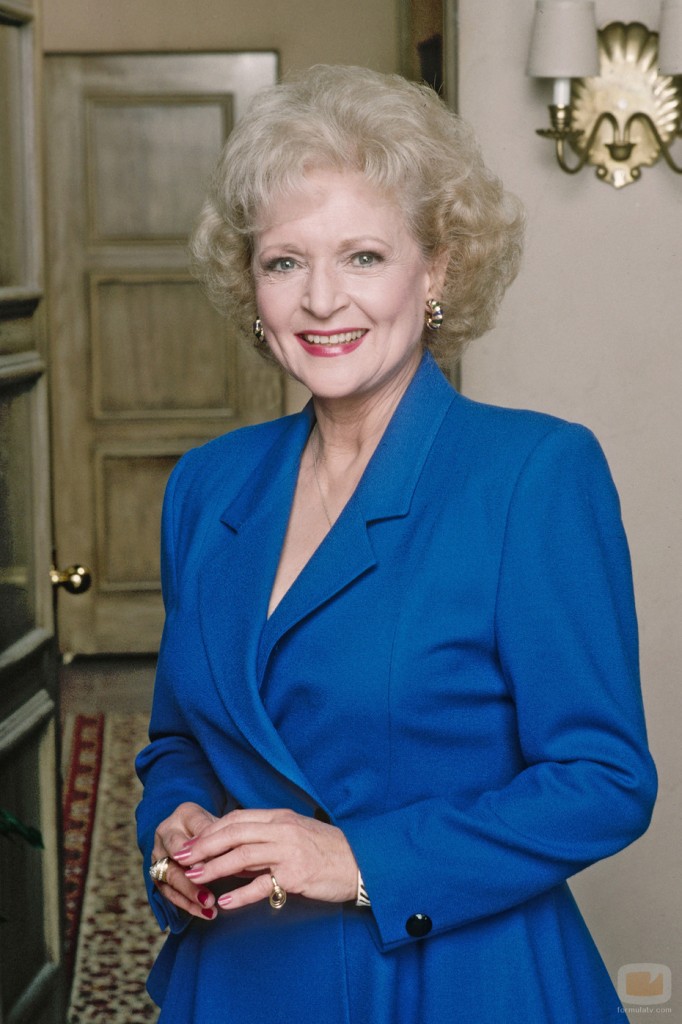
OK, can someone please explain this sudden burst of cultural currency afforded to Betty White?  Don’t get me wrong – I’ve got no beef with said popularity resurgence, quite to the contrary.  B-dubbs and I go back – way back – to the days of Sue Ann Nivens on MTM (not to be confused with MTT) and her work on the Golden Girls informed my childhood, youth, and young adulthood (to which I still desperately cling).  I mean, come on, “Miami, you’re cuter than… an inter-uteran…” ??  That’s pure gold.

So, this is not meant as any kind of a criticism, just a statement of curiosity.  For someone who has been intimately (well, not intimately) familiar with Betty’s work for so long, it comes as a sort of gratifying but confusing turn of events that she would gain so much in popularity after having gained so very much in age (she’s 88).

Am I wrong, or did it all start with the whole Facebook groundswell to get her to host Saturday Night Live?  And what was that all about?  Now she’s on the Emmy’s, has a whole bevy of guest appearances on other TV shows, and is even starring in her own sitcom on TVland?

Again, don’t get me wrong, I love the woman dearly, but it all just comes as a bit of a surprise?  Anyone?  Maybe Betty and the rest of the Girls made some kind of pact that the last one alive would harness the combined powers of the other three and ride the wave to a new brand of stardom… or was it that they would all have their heads frozen?

Necessary juxtaposition

I’m sorry, but I just think these two videos need to share the same space:

Final thought: A few weeks ago, I was hanging out with my friend Eric in the avant-hipster Greenpoint neighborhood of Brooklyn.  It is entirely possible that both of these videos were spliced together using candid footage from this region.

The Sound that Says “Love”

I attended last night’s penultimate concert of the Grant Park Symphony Orchestra and Chorus Season – Mahler’s Symphony No. 2.  The rendition was simply splendid: the playing brilliant, the singing lustrous, the chorus precise, warm and immensely clear in their diction.  Basically, it was a great concert – even greater because the outdoor, somewhat casual setting gives me an opportunity to pontificate on one of my favorite subjects: applause.

See, you’re probably thinking – especially those of you who know me – that I am setting up to chastise the hoi polloi for their inter-movement ovations.  Nothing could be further from the truth!  Those of you who really know me (you lucky little cherubs) know that applauding between movements of a symphony or concerto (especially one written prior to the 20th century) is something that I whole-heartedly endorse!

For me, the best “inappropriate applause” last night came at the moment in the score when the development goes slamming into the recap of the colossal first movement.  You know the spot:

What better place to applaud?  The thing that I enjoyed most about applauding right there (which I did) was that it felt like that gut reaction of clapping when a really great rock guitar solo in a concert matches exactly (artlessly?) what you heard on the album -  not the knowing applause of the cognoscenti that follows a solo jazz improvisation.  At least, that’s what it was in my mind anyway.*  I just thought that such great, vehement playing of 2’s against 3’s really deserved some applause!

Alex Ross wrote a famous article on this subject in The Guardian, but unfortunately he stopped short of endorsing a new era of applauditory freedom.  See, the thing is, I wouldn’t be so very much in favor of applauding between movements were it not for the fact that composers specifically designed their pieces to elicit applause at the ends of movements.  So many letters have been handed down to us from antiquity in which the great composers take considerable delight in having a first or an inner movement applauded so much that they even had to repeat it.

Of course, the big problem is that certain places demand applause while others achieve a far greater effect by forgoing it, even in moments of exalted excitement.  In Mr. Ross’s article, he mentions the case of the third movement of Tchaikovsky’s Pathétique Symphony – which happened to be on the radio as I was driving home from the concert last night, incidentally – and which goes a little something like this:

Seems like the perfect place for applause, right?  Well, it would be, were it not for the fact that this exuberant finale happens to be followed by the most heart-wrenching suicide note of a movement ever penned:

To me, the big effect here is the startling, knock-the-air-out-of-you change of mood (or, let’s say “affect“).  The colossal weight of the fourth movement loses all of its impact if it doesn’t shock you out of the march’s vigorous mood – the effect should be akin to dousing a red hot iron with the Arctic Ocean.  I prefer to time it something like this:

or maybe even spaced a little closer together, just to be audacious.  Whatever it takes to give the audience even an inkling of Piotr Ilyitch Tchaikovsky’s inner turmoil.

But how to do it?  How can one possibly stop the inevitable outpouring of cheers and clapping at the end of a thrilling march like the third movement?  I think that an explanation before the beginning of the entire symphony would be a great place to start.  Explain and demonstrate to the assembled spectators just what it is that Tchaikovsky was trying to achieve with this stark juxtaposition and why they are in for a deeper, more thrilling emotional experience if they take the plunge into the fourth movement without any pause.

So, I suppose that my solution to the applause conundrum is to have audiences be completely educated and enlightened to the point where they can anticipate every nuance of a piece and respond to it according to my exact taste.  And when I’m Music Director of the World, that’s exactly what I intend to have happen.

Speaking of Alex Ross, is everyone aware of this?


*[Ed: “Are you saying “boo” or “boo-urns”?]

Where to begin?

The time comes a time in every blogger’s life when he must apologize for an extended absence, and now’s my time, so, Sorry.  Since last we spoke, I’ve been in a sort of Dustin-Hoffman-in-The-Graduate-esque daze, wandering from town to town like a half-drunk mosquito on a hot summer’s night.  I’m looking for some kind of conducting job since I’ve got, like, a degree in it now, but perhaps it’s time for a different approach.  The good news is that it looks like I’ll be able to scrape by on commissions for the next few months.

Speaking of composing, I finally premièred and recorded a piece that I wrote a year and a half ago, my Madrigal a 5 voci for Brass Quintet.  Which, if you happen to listen to, you might want to know contains my personal favorite ending of any piece of mine – a perfect fifth with a very flat major third, formed by the horn playing an open harmonic Bb (7th partial).  It’s in between a major third and a minor third – you might call it a “neutral third”, though it’s anything but.  Oh, I can’t help myself, here’s what it sounds like:

If something that wretchedly discordant doesn’t make you want to listen to the entire piece, I don’t know what will.

OK, another musical recommendation: the new album by Argentine “jazz” pianist Guillermo Klein, Domador de Huellas: Music of Cuchi Leguizamón.  I render the word jazz as a quotation because Sr. Klein rejects labels of all sorts, and considers himself merely a composer who works in a variety of idioms.  My acquaintance with the music of Sr. Klein came about because my good friend Eric “El Bensón” Benson spent a great deal of time in Buenos Aires a few years ago getting to know the man himself and the circle of musicians surrounding him.  Eric has been posting several interviews with the musicians on this album that he himself conducted at his blog Inverted Garden.  He has also been hard at work producing a radio mini-documentary on the album.  All highly recommended, despite the fact that this is certainly “fringe” repertoire if ever there were any – an obtusely named album (trans: Tamer of Footprints, I think?) devoted to the works of an Argentinian folk composer that most Argentinians have never heard of.  Great stuff.

Back to me now, since wrapping up the season of Monteux School in Maine a few weeks ago, I’ve been wandering down the East Coast, staying at the homes of various composers, writers, musicians, etc. – you know, the sort of East Coast Bohemian Élite that is my social group.  Return visits to the Midwest and Californ-I-A are on the docket.  One stop on this tour was a visit to a rehearsal of the BSO at Tanglewood with my good friend, the cellist Daniel Lelchuk.

This particular rehearsal offered much to talk about, almost all of it concerning the conductor (a major international podium presence) and just how indecipherable his motions were on the podium.  I had recently seen this particular conductor at work with the Chicago Symphony and let me just say that this rehearsal confirmed my worst impressions.

In the following days, I had the chance to discuss this rehearsal with some fellow musicians, but the more interesting conversations were with interested music lovers.  These people invariably begin their comments by admitting their lack of expertise.  They then go on to say why they like certain conductors but have trouble with others.  In every case, the layman’s opinion matches the musical worth (from my point of view, at least) of the conductors in question.

All this is to say that conducting is really not anything tricky to judge, much of the time.  I am a firm believer that any audience member who truly enjoys classical music on a gut level should be able to watch a conductor and judge his basic worth.  Do his physical movements seem to match the tempo, dynamic and “coloration” of the music?  Does his manner change when a major event in the music happens?  Or does he seem to be doing one thing and the musicians another?  Take for example:

For the most part, the conducting here seems removed from the music itself, frequently in terms of the basic pulse (which, YES, ought to be the minimum requirement for good conducting, although the fashion seems to be to ignore this entirely.  I’m not saying that a conductor has to beat all the time – or even most of the time in certain pieces – but if he beats, his beat damn well ought to be clear and connected to the musical fabric.)

Now take this (same piece):

I’m sick and tired of hearing about how Bernstein’s so-called “podium antics” were over the top, etc.  They weren’t.  Now, that’s not at all to say that his interpretations didn’t push the limits of good taste -  quite often, they did.  The distinction that I’m trying to make is that his bodily movements always communicated the music exactly as he understood it.  You may (as I do) disagree with what he was trying to do, but you can’t disagree with how he did it.

So take heart, you denizens (well, citizens at least) of the “uninitiated” orchestral audience – you are perfectly entitled to your opinion, and if what you see doesn’t match what you hear, there’s probably something wrong.

Time to update that resume

The New York Times reports that the orchestral world is ripe with job openings: 12 vacancies in the New York Phil, 10 in Boston, 9 in Chicago, 7 in L.A., etc.  To all my friends who are struggling young musicians hoping for their first big chance, I wish you the very best.

Interestingly, it seems that there are a spate of conducting openings of late too: Kahane Withdraws from Bach Festival, Kent Nagano Reportedly Stepping Down from Bavarian State Opera, Philharmonic’s Conductor Bows Out, Conductor Leaving El Paso Symphony, Orchestra Conductor Departs.

And I kind of think there might be an opening at the Russian National Orchestra, since Mikhael Pletnev has his hands tied up with other things right now.